
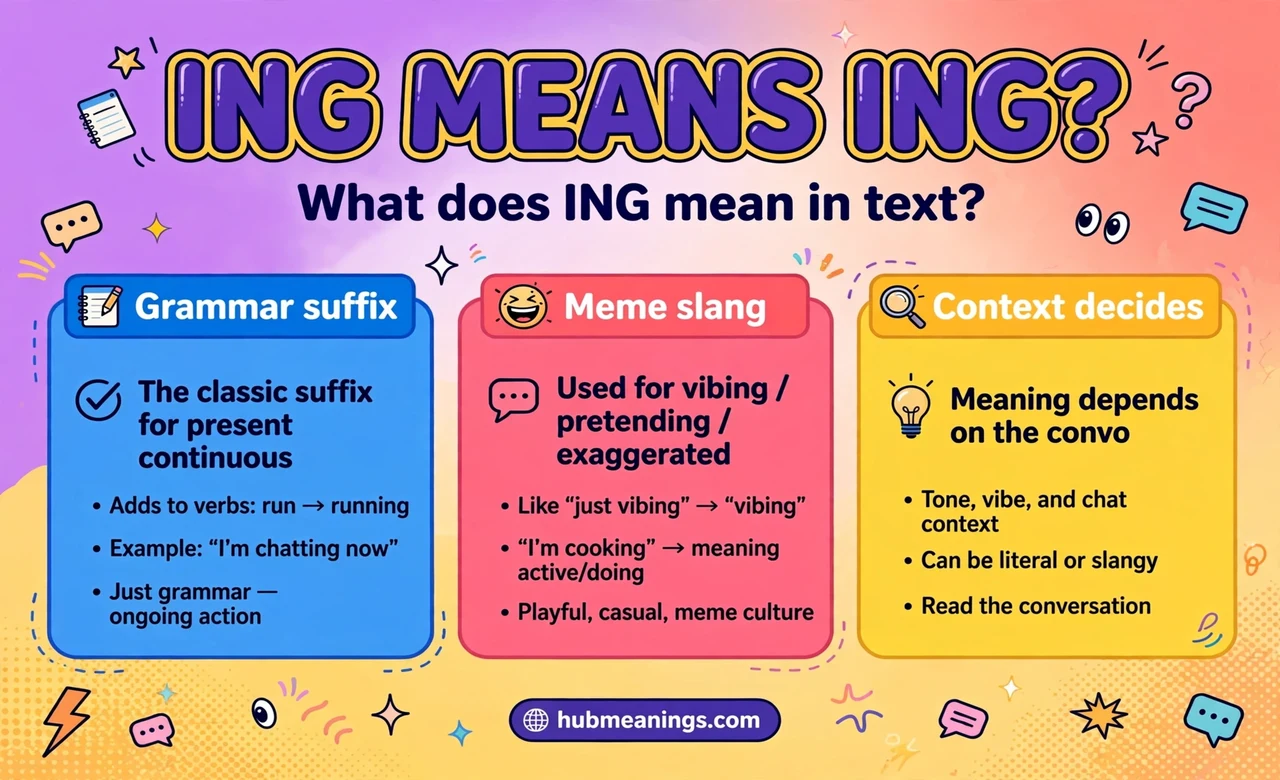
If you have typed ing meaning in text into Google, you have probably noticed something strange: every guide seems to answer a slightly different question. One page tells you ING is an abbreviation for “it’s not good.” Another says ING is not an abbreviation at all, just the ordinary -ing ending of English grammar.
A third says it is Gen Z meme slang, the kind of word that shows up in a TikTok comment as “bro is just ing” with a skull emoji. All three of these answers are partly right, and none of them is the whole story. That is what this guide is for. It gives you the honest, complete picture of what does ing mean in text messages, in chats, and on Snapchat, Instagram and TikTok, without pretending the answer is simpler than it is.
ING Meaning in Text: Quick Answer
ING has no single settled meaning in texting. Context decides.
ING can be the ordinary -ing grammar suffix showing an ongoing action (“I am driving”), standalone meme slang implying an unnamed ongoing action as a joke (“he is just ing”), or shorthand for “it’s not good” (“That movie was ing”). Read the whole sentence before you pick one. The words around ING, the topic of the conversation, and the app you are on will tell you which reading fits.
Quick examples:
- “I am driving, call you later.” = The grammar suffix. Ongoing action.
- “Bro is just ing, do not ask.” = Meme slang. Unspecified action, meant as a joke.
- “The new update? ING.” = “It’s not good.” A one word review.
- “We are thriving today.” = Stylized -ing wordplay. Playful and casual.
On Snapchat, ING is most often the grammar suffix.
Snapchat chats are fast and about the present moment, so “ing” words like driving, snapping, studying and chilling dominate. The meme reading appears too, but the grammar reading wins on volume.
On TikTok, the standalone meme slang reading is the most common.
TikTok comments and captions are where “ing” floats alone as a joke, often paired with the skull or crying laughing emoji. If you see “ing” with no verb attached on TikTok, assume the meme reading first.
The “it’s not good” reading is the least common but real.
It appears as a short reaction to bad news, a bad movie, or a bad idea. It is documented by abbreviation guides, but it is far less widespread than the grammar and meme readings. Do not force it onto messages where the grammar reading fits perfectly.
That is the quick answer: three readings, context decides, and the sentence around ING is always your guide. The sections below explain each reading in full, with examples, tone notes, replies, and app by app coverage.
Why ING Is Unsettled: The Honest Explanation
Most slang guides pick one lead meaning and pretend the rest barely exist. That does not work for ING, because the evidence genuinely points in several directions, and the sources say different things.
The case for the grammar suffix: this is the oldest and by far the most frequent use. Every time someone texts “I am running late”, “we are leaving now”, or “she is studying”, the -ing ending is doing its ordinary grammatical job, forming the present participle to describe an action happening right now. SlangSphere and texting.io both describe this as the core reading. If you count raw occurrences in real chats, this reading wins by an enormous margin, because almost every message about the present moment contains an -ing word.
The case for the meme slang: meaningloops.com argues this is where most search intent is actually pointed, and that is a fair claim. Nobody searches Google to learn that “running” contains -ing. People search because they saw “ing” standing alone in a comment or a chat and could not figure out what it meant. The standalone meme slang, “he is just ing”, grew out of mid 2010s absurdist internet humor and was accelerated by TikTok and gaming communities. It is the fastest growing reading and the one most likely to confuse you, which is why this guide gives it full treatment.
The case for “it’s not good”: 7esl.com presents this as the meaning of the acronym ING, with examples like “I just watched the sequel. ING!” StreetSlang style acronym lists agree that ING can stand for “it’s not good”. This reading is real, but it is the least universal of the three. It lives in reply style texting, short reviews, and reactions to bad news. It is also the reading most likely to be confused with the grammar suffix, because “that was ing” could be a clipped judgment or just a fragment of a longer thought.
None of these sources is wrong. They are describing different slices of real usage. The grammar reading dominates everyday typing. The meme reading dominates TikTok comments and Gen Z group chats. The “it’s not good” reading dominates short reactions. The mistake is assuming one slice is the whole thing. This guide does not make that mistake. It treats all three readings as live, and it teaches you the sentence shapes that reveal each one.
<!– IMAGE 2: in-article image goes here (ing-meaning-suffix) –>
ING as the Grammar Suffix: The Ongoing Action Meaning

The most common ING in your messages is not slang at all. It is the ordinary English -ing suffix, the ending that turns a verb into its present participle form to describe an action that is happening right now or ongoing.
Why it matters for texting: texting is a medium of the present moment. People text about what they are doing, what is happening, and what is about to happen. That means -ing words appear constantly: going, coming, driving, working, studying, eating, watching, waiting, thinking, trying. When someone asks what does ing mean in texting, the boring but correct answer for most messages is that it means the action is in progress.
How it works in grammar: the -ing suffix attaches to a verb to form the present participle, which combines with a form of “be” to make the present progressive tense. “I am walking” means the walking is happening now. In texts, the “am” often gets dropped for speed, but the -ing still carries the ongoing meaning. “Driving, call you in 10” is understood as “I am driving, I will call you in 10.”
Examples:
- “I am running late, start without me.” = The running is happening now. Grammar reading.
- “We are leaving in five.” = The leaving is imminent and in progress. Grammar reading.
- “She is studying for finals.” = Ongoing activity. Grammar reading.
The -ing suffix also forms gerunds, which are verb forms that act as nouns. “Swimming is my favorite workout” uses swimming as a noun. In texts this shows up in phrases like “Gaming tonight?” or “Shopping was a mistake.” Same suffix, same ongoing action idea, just used as a thing rather than an action.
How to recognize this reading: the -ing is attached to a verb, and the sentence is about something happening, in progress, or planned. If removing the -ing word would break the sentence’s grammar, you are looking at the grammar reading. This is the default assumption. Only switch to another reading when the grammar reading clearly does not fit, for example when “ing” stands completely alone with no verb attached.
A note on frequency: if you are learning the ing meaning in text messages to understand your own chats, start here. The vast majority of ING you will ever see is this reading. The meme and acronym readings are real but rare by comparison. Master the common case first, then learn the jokes.
ING as Standalone Meme Slang: “He Is Just Ing”
This is the reading that sends people to Google. Somewhere in the mid 2010s, internet users started dropping the verb entirely and leaving just the -ing ending floating on its own, and a joke was born.
The setup: “Why is Jake acting weird?” The punchline: “Bro is just ing.” There is no verb. The speaker is implying an ongoing action without naming it, and the vagueness is the entire joke. It suggests that whatever Jake is doing is so odd, so dramatic, or so hard to explain that it cannot be put into words. The listener is left to imagine the worst, or the funniest, possibility.
Why it is funny: the humor comes from treating regular behavior like a category or an ongoing performance. The -ing ending normally promises a specific action: running, eating, crying. When the action never arrives, your brain fills the gap, and the gap is funnier than any specific verb would be. It is absurdist humor in its purest texting form, a close cousin of the Gen Z habit of describing moods as ongoing bits.
Where it lives: this reading is native to TikTok comments and captions, Twitter style posts, and Gen Z group chats. It is often paired with the skull emoji or the crying laughing emoji, which signal that the vagueness is deliberate. On Instagram it appears in meme page captions. On Snapchat it appears in friend chats reacting to something strange. It is strictly casual. You will never see it in a work email, and using it there would be a genuine mistake.
Examples:
- “He is just ing, do not ask.” = He is doing something weird and unnamed. Meme reading.
- “Me pretending everything is fine and ing through it.” = Coping as an ongoing performance. Meme reading.
- “The group chat is ing again.” = The chat is doing its usual chaotic thing. Meme reading.
How to recognize this reading: “ing” stands alone or nearly alone, with no verb attached, and the sentence would make no grammatical sense if you tried to read it as the suffix. “He is just ing” has no verb for the -ing to attach to. That missing verb is the signal. When you see it, do not try to expand it into a full word. The joke is that there is no full word.
The origin story, honestly told: this usage grew out of early 2010s absurdist internet humor, the same soil that produced deliberately broken memes and anti jokes, and it was accelerated by TikTok and gaming communities in the late 2010s and early 2020s. It is community driven and still shifting, which means no dictionary fully owns it. That is normal for meme slang. It does not make the reading less real.
A related style worth knowing: StreetSlang describes the clipped -ing caption style, where people attach -ing to nouns and phrases to make them sound like ongoing actions: “just girling”, “we are thriving”, “adulting is hard”. This is the same family as the standalone meme slang, but with a word attached. “Thriving” as a caption does not describe a specific action. It frames a mood as a performance. If you understand the standalone joke, you will understand this style too.
<!– IMAGE 3: in-article image goes here (ing-meaning-meme-slang) –>
ING as “It’s Not Good”: The Reaction Shorthand
The third reading treats ING as a genuine acronym, and it is the one most abbreviation guides lead with. In this reading, ING stands for “it’s not good.”
How it is used: as a short, blunt reaction to bad news, a bad experience, or a bad idea. Someone texts “I failed my driving test” and the reply comes back “ING.” Someone posts “Just watched the new sequel” and a friend comments “ING, wait for streaming.” The meaning is a compressed negative review, a way to say “that is not good” without typing the whole judgment.
Where it lives: this reading appears in reply style texting, in comment sections, and in casual group chats. 7esl.com documents it with texting and social post examples. It is most at home in quick back and forth conversations where brevity is valued and the topic is clearly something disappointing.
Examples:
- “The restaurant was ing, do not bother.” = The restaurant was not good. Acronym reading.
- “How was the exam?” “ING.” = It did not go well. Acronym reading.
- “That idea is ing, trust me.” = That idea is not good. Acronym reading.
How to recognize this reading: ING appears as a standalone judgment about something already mentioned, usually something negative, and the sentence makes sense if you substitute “it’s not good.” The topic is almost always a review, a complaint, or a warning. If the message is about plans or ongoing actions, this reading is probably wrong.
An honest caveat: this is the least universal of the three readings. Many fluent texters have never seen it, and some guides that claim it as the primary meaning are describing a narrower slice of usage than they admit. It is real and documented, but it is not the first reading to try. Try the grammar reading first, then the meme reading, and reach for “it’s not good” only when the message is clearly a negative reaction. When in doubt, the surrounding topic is your best clue: bad news plus standalone ING usually equals “it’s not good.”
12 Real Chat Examples
Here are 12 realistic texting exchanges showing ING in the wild, each labeled with its reading so you can see how context decides.
- “Where are you?” “Driving, be there in 10.”
Reading: Grammar suffix. The driving is happening now. Nothing slang about it. - “Why is your brother laughing like that?” “He is just ing, do not ask.”
Reading: Meme slang. No verb attached, the vagueness is the joke. - “How was the movie?” “ING. Wait for streaming.”
Reading: “It’s not good.” A compressed negative review. - “We are leaving now, meet us outside.”
Reading: Grammar suffix. The leaving is in progress. - “The group chat at 2am is just ing.”
Reading: Meme slang. The chat’s chaotic behavior is unnamed on purpose. - “I am studying for finals, text you later.”
Reading: Grammar suffix. Ongoing activity, standard texting. - “Did you try the new update?” “Yeah. ING.”
Reading: “It’s not good.” A one word verdict on the update. - “Me pretending I have my life together and ing through it.”
Reading: Meme slang, in the clipped caption style. Coping framed as a performance. - “She is working late again.”
Reading: Grammar suffix. Nothing hidden, just an ongoing action. - “That restaurant everyone hyped? ING.”
Reading: “It’s not good.” A review disguised as a shrug. - “We are thriving today, no complaints.”
Reading: Stylized -ing wordplay. A mood framed as an ongoing action, playful and casual. - “What is he doing in there?” “Ing.”
Reading: Meme slang in its purest form. One word, no verb, maximum vagueness.
Notice the pattern across all 12: the grammar examples have verbs attached and describe real ongoing actions. The meme examples have no verb, or use -ing as a stylistic flourish, and the humor depends on that gap. The “it’s not good” examples are reactions to something disappointing. Once you see the pattern, you will sort new examples the same way without thinking.
How to Reply to ING

Your reply depends entirely on which ING you just received, so the first step is always to identify the reading using the sentence around it.
If it is the grammar suffix, reply to the action, not the suffix. “Driving, be there in 10” gets “No rush, drive safe.” “I am studying for finals” gets “Good luck, you have got this.” There is nothing special to decode. Treat it like any normal message about what someone is doing.
If it is the meme slang, play along or ask for the story. “He is just ing, do not ask” can get “Now I have to ask” or a skull emoji back. The joke invites curiosity, and asking “ing what exactly” is itself part of the bit. In a group chat, the best reply is often another vague -ing joke: “we are all ing at this point.”
If it is the “it’s not good” reading, respond to the judgment. “The movie was ING” gets “Oh no, what was wrong with it?” or “Glad I skipped it then.” You are replying to a negative review, so sympathy or curiosity fits.
What not to do: do not reply to the meme slang with confusion that kills the joke, like a long serious question about grammar. And do not treat the grammar suffix as slang. Replying “what does ing mean” to “I am driving” will confuse the other person, because to them nothing slang happened. Match your reply to the reading, and when you are unsure, a light “haha what” works for the meme reading while a normal reply works for the grammar reading.
ING Tone Guide
Tone is part of meaning with ING, because the same letters feel completely different in each reading.
The grammar suffix has no tone of its own. It is neutral, the same as any ordinary word. “I am working” is as toneless as “I work.” The tone comes from the rest of the message, not from the -ing.
The meme slang is playful, ironic, and deliberately unserious. It signals that the speaker is joking, that the situation is absurd, and that everyone involved is in on it. It is warm among friends and baffling to outsiders, which is part of the point. Gen Z group chats use it as a bonding signal: if you get the joke, you belong.
The “it’s not good” reading is blunt and dismissive. It is a shrug in text form. It can be funny among friends roasting a bad movie, but it can also read as cold if the topic is someone’s bad news. “I failed my test” answered with “ING” is brisk to the point of harshness. Know your audience before you use this reading.
Across all three, ING is informal. None of the readings belong in professional writing, job applications, or messages to people who expect formal English. The grammar suffix is fine everywhere because it is just grammar, but the meme and acronym readings are casual only.
Read more:ALR Meaning in Text
ING on Snapchat
Snapchat is the home turf of the grammar reading. The app is built around the present moment: what you are doing, where you are, what is happening right now. That means -ing words dominate Snapchat chats naturally.
Typical Snapchat ING: “omw, driving”, “snapping you in a sec”, “studying, reply later”, “chilling at home”. None of this is slang. It is fast typing about ongoing actions, and the -ing ending is doing exactly what grammar textbooks say it does.
The meme reading on Snapchat: it appears, but less than on TikTok. A friend reacting to a strange story might reply “he is just ing” to a snap. The private, fast nature of Snapchat chats makes the joke land well, because the vagueness invites a follow up question, and Snapchat is built for follow ups.
The “it’s not good” reading on Snapchat: rare. Snapchat conversations move too fast for compressed reviews, and the acronym reading needs a topic to react to. It can appear in replies to stories, but it is not typical.
How to read ING on Snapchat: default to the grammar reading. If the message describes an action in progress, that is your answer. Switch to the meme reading only when “ing” stands alone with no verb and the context is clearly a joke.
ING on Instagram
Instagram is the home of the stylized -ing caption. The platform rewards clever captions, and the clipped -ing style that StreetSlang describes is a caption writer’s tool: turn a mood into an ongoing performance.
Typical Instagram ING: “adulting”, “thriving”, “barely surviving”, “just girling”, “weekending”. These are not describing specific actions. They are framing an attitude as a continuous state, and the -ing ending is what makes it feel alive and in progress. A photo captioned “thriving” does not tell you what the person is doing. It tells you how they feel about what they are doing.
The meme reading on Instagram: common in meme page captions and comments. “POV: the group chat is ing” is a standard meme format. The comment section is where the standalone joke thrives, often with emoji reinforcement.
The grammar reading on Instagram: present in DMs, where people chat the same way they chat anywhere. “I am running late” in an Instagram DM is the same as in any other chat.
The “it’s not good” reading on Instagram: appears in comments as a short review. “The lighting in this one is ing” is the kind of compressed critique 7esl.com documents. It is real but uncommon.
How to read ING on Instagram: in captions, expect the stylized wordplay. In comments, expect the meme reading. In DMs, expect grammar.
ING on TikTok
TikTok is where the standalone meme slang reading rules. The platform’s comment culture is built on absurdist humor, and “ing” floating alone as a word is a native TikTok joke.
Typical TikTok ING: comments like “bro is just ing”, “the way this video is ing”, “me ing through the week”. The vagueness is the point, and the audience is expected to get it without explanation. Text overlays on videos use the same style, often paired with the skull emoji to mark the joke as deliberate.
Why TikTok fits this reading: TikTok humor rewards compression and shared references. A three letter fragment that implies an entire unnamed situation is the perfect TikTok comment. It is also where the reading spreads fastest, because comments are public and trends replicate in hours.
The grammar reading on TikTok: present in comments describing the video (“she is really going through it”), but unremarkable. Nobody notices it, which is exactly the point.
The “it’s not good” reading on TikTok: appears in comments as a verdict. “This trend is ing” is a dismissal. It works because TikTok comments are full of hot takes, and ING is a compressed one.
How to read ING on TikTok: if “ing” stands alone with no verb, assume the meme reading first. It is the fastest growing use of the term and the most search driven, which is probably why you looked it up in the first place.
The Short History of ING: From Grammar to Meme
The -ing suffix is one of the oldest working parts of English. It comes from Old English and has been marking ongoing action for over a thousand years. Every “running”, “eating” and “sleeping” you have ever typed is part of that unbroken history. This is the deep background of every ING you will ever see.
The texting era added speed but not new meaning. When SMS made brevity valuable, people kept the -ing because it carries so much meaning in three letters: ongoing, now, in progress. “Driving” in a text is worth a full sentence. The grammar reading did not change. It just got more screen time.
The meme era is recent. In the mid 2010s, absurdist internet humor started detaching the suffix from its verb, and the standalone “ing” became a joke about vagueness itself. TikTok and gaming communities accelerated it in the late 2010s and early 2020s, and by 2026 it is a recognized Gen Z slang pattern, documented by slang guides even though no dictionary fully owns it.
The acronym reading’s history is murkier. Abbreviation guides list ING as “it’s not good” without a clear origin story, which suggests it emerged organically in reply style texting rather than from a single viral moment. It is the kind of shorthand that many small groups invent independently, which also explains why it is real but not universal.
What this history tells you: ING is a word with a thousand year old core and a ten year old joke layered on top, plus a floating acronym reading that may have been invented many times over. That layering is exactly why the honest answer is “it depends.”
Common Mistakes With ING
Mistake one: assuming ING always means “it’s not good.” This is the most common error, and it comes from reading abbreviation guides as if they describe all of texting. In real chats, the grammar reading outnumbers the acronym reading enormously. “I am driving” is not a complaint.
Mistake two: trying to expand the meme slang into a full word. “He is just ing” is not short for anything. There is no missing verb to recover. The joke is the absence. Asking “ing what” as a serious grammar question misses the point, though asking it playfully is part of the fun.
Mistake three: using the meme or acronym reading in formal writing. The meme slang is strictly casual, and “it’s not good” as ING will baffle anyone outside casual texting culture. In a work email, ING should only ever appear as the ordinary grammar suffix inside normal words.
Mistake four: confusing ING with the trademark style initialism. ING is also a famous brand name, the Dutch bank, and in branding contexts ING means the company, not any texting slang. Context is everything: a bank logo and a TikTok comment are different worlds.
Mistake five: reading emphasis as meaning. Sometimes people stretch the suffix for effect, “runnnnning”, and the stretched -ing is just excitement, not a new reading. Do not overthink it.
When to Use ING and When Not To
Use the grammar suffix freely. It is correct English in every register, from texts to dissertations. There is no situation where “I am working” is wrong because of the -ing.
Use the meme slang only with people who will get the joke. Friends, group chats, TikTok comments, meme pages. It is a bonding signal, and it only works when the audience shares the reference. With parents, teachers, or professional contacts, it will read as a typo.
Use the “it’s not good” reading sparingly, and only where brevity is valued and the topic is clearly negative. Among friends roasting a bad movie, it is funny. As a reply to someone’s genuine bad news, it can read as cold. When the stakes are emotional, type the full sentence instead.
Never use the meme or acronym readings in formal writing: job applications, work emails, messages to professors, or anything you want taken seriously. The grammar suffix is always safe. The slang readings never are.
When you are unsure which reading someone else meant, the safest move is to respond to the most likely one and keep it light. If you guessed wrong, the conversation will correct you in one exchange, and no harm is done.
<!– IMAGE 5: in-article image goes here (ing-meaning-examples) –>
Frequently Asked Questions About ING Meaning
1. What does ING mean in text?
ING has three live readings in texting: the ordinary -ing grammar suffix showing an ongoing action (“I am driving”), standalone meme slang implying an unnamed action as a joke (“he is just ing”), and shorthand for “it’s not good” (“That movie was ing”). Context decides which one applies.
2. What is the most common meaning of ING?
The grammar suffix, by an enormous margin. Almost every message about something happening right now contains an -ing word. The meme and acronym readings are real but far less frequent in raw message counts.
3. What does ING mean on Snapchat?
On Snapchat, ING is most often the grammar suffix, because Snapchat chats are about the present moment: “driving”, “snapping”, “studying”. The meme reading appears in reactions to strange stories, but the grammar reading dominates.
4. What does ING mean on Instagram?
On Instagram, expect the stylized -ing caption style: “thriving”, “adulting”, “just girling”, where the suffix frames a mood as an ongoing performance. In comments, the standalone meme slang is common. In DMs, it is usually just grammar.
5. What does ING mean on TikTok?
On TikTok, the standalone meme slang reading is the most common. Comments like “bro is just ing” use the floating -ing as an absurdist joke, often with the skull emoji. If you see “ing” with no verb attached on TikTok, assume the meme reading first.
6. Is ING a real word?
As a standalone word, ING is slang, not dictionary standard English. The -ing suffix is completely standard grammar. The meme and acronym readings are community driven and still evolving, which is normal for internet slang.
Conclusion
The ing meaning in text is not one thing, and this guide has been honest about that from the first paragraph. ING is the ordinary -ing grammar suffix in most of your messages, marking ongoing action the way it has for a thousand years. It is standalone meme slang on TikTok and in Gen Z chats, where “he is just ing” turns vagueness into a joke. And it is occasionally shorthand for “it’s not good,” a compressed verdict in reply style texting. The sources disagree about which reading leads because each one is describing a different slice of real usage, and all three slices are genuine.
What you should take away is not a single definition but a method. When you see ING, check whether a verb is attached. If yes, it is almost certainly the grammar suffix, and you can move on. If “ing” stands alone, check the topic: a joke context means the meme reading, a disappointing topic means “it’s not good.” Check the app too. Snapchat leans grammar, Instagram leans stylized captions, TikTok leans meme. With those three checks, verb, topic, and app, you will read ING correctly almost every time.

Hi, I’m Alice, a writer at HubMeanings, where I make confusing words, slang, and phrases easy to understand.
I love exploring language and sharing clear, simple meanings with practical examples.