
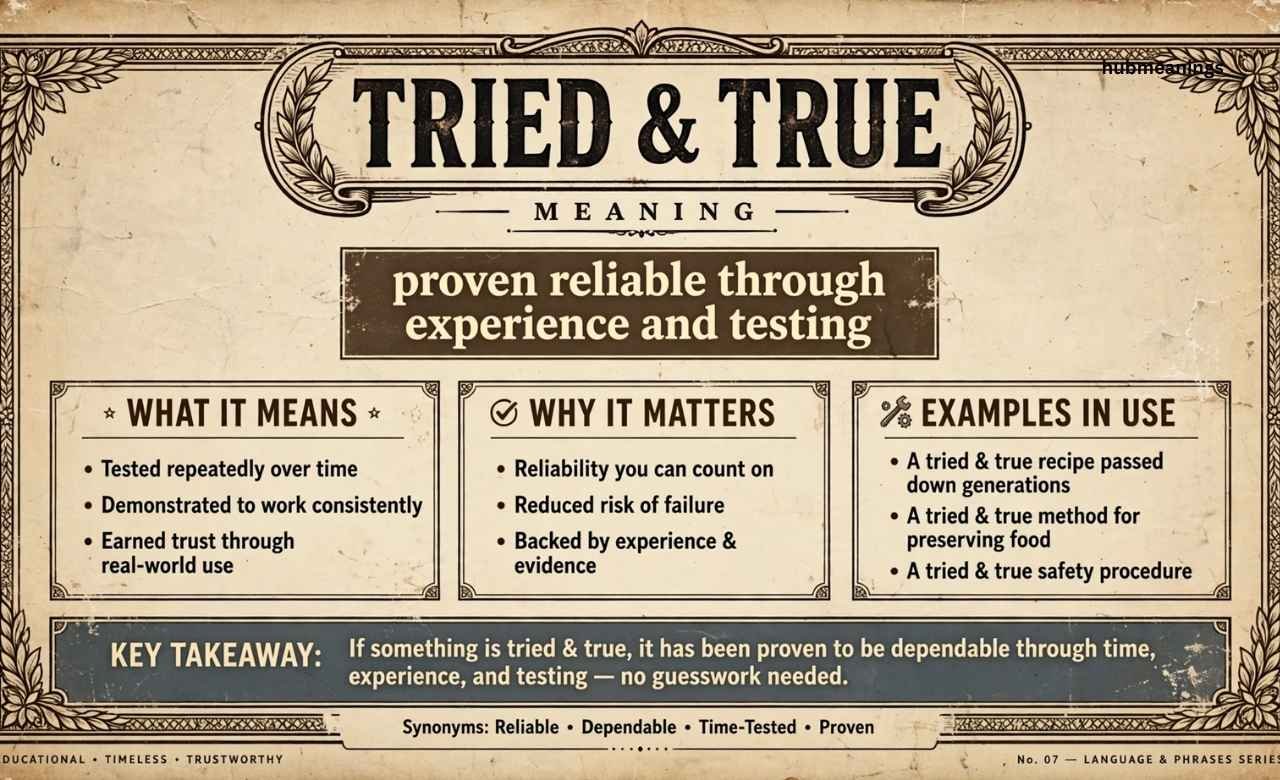
Have you ever heard someone call a method, person, or solution “tried and true” and wondered what it actually means? The tried and true meaning refers to something that has been tested through experience and proven to be reliable, effective, or trustworthy. Whether it’s a favorite recipe, a successful strategy, or a dependable friend, the phrase describes something people can confidently rely on.
In this guide, you’ll learn what does tried and true mean, how to use the phrase correctly, its meaning in different contexts, common Tried and True Meaning examples, synonyms, and the difference between “tried and true” and similar expressions like “tried and tested.” By the end, you’ll know exactly when and how to use this popular English phrase naturally.
What Does “Tried and True” Mean?

The phrase “tried and true” is a common English expression used for something that has been tested over time and demonstrated that it can be trusted. It often describes an idea, method, approach, product, system, or person with a history of dependable performance.
When someone says, “This is a tried-and-true method,” they are saying that the method is not merely theoretical or experimental. It has already been used successfully, often many times, and people Tried and True Meaning have confidence in it because of that experience.
The expression combines two related ideas:
- Tried means tested, experienced, or put into practical use.
- True suggests reliable, faithful, dependable, or trustworthy.
Together, these words communicate the idea of something that has been tested and proven reliable.
For example:
“Email marketing is a tried-and-true way to communicate with customers.”
Here, the speaker is emphasizing that email marketing has been used successfully for a long time and has a proven track record.
The phrase can describe both things and people. A tried-and-true solution is a dependable solution, while a tried-and-true friend is someone who has demonstrated loyalty and dependability over time.
Tried and True Simple Definition
A simple tried and true definition is:
Tried and true means tested through experience and proven to be reliable, effective, or trustworthy.
Think of it this way:
Tried = tested.
True = dependable.
Therefore:
Tried and true = tested and dependable.
Suppose you have used the same recipe every holiday for 15 years, and it always produces good results. You could call it your tried-and-true recipe.
Likewise, if a company has used the same customer service process successfully for many years, it could describe that process as a tried-and-true practice.
The expression usually carries a Tried and True Meaning positive meaning. It suggests confidence based on actual experience rather than a guess or promise.
Some closely related ideas include:
- reliable
- proven
- dependable
- trustworthy
- effective
- established
- time-tested
- successful
- consistent
However, “tried and true” has a slightly different feeling from simply saying “good.” It specifically emphasizes previous testing and demonstrated reliability.
Tried and True Meaning in Simple English
In simple English, tried and true means “something that has worked well before and can be trusted to work again.”
For example:
“This is a tried-and-true study method.”
In simple English, this means:
“This study method has worked successfully before, so we trust it.”
Another example:
“She has a tried-and-true morning routine.”
This means:
“She has a morning routine that she has used successfully and knows works well for her.”
The phrase can therefore be understood as a combination of experience + reliability + confidence.
If someone recommends a tried-and-true product, they are usually saying, “I know this works because it has worked before.”
If someone recommends a tried-and-true strategy, they mean the strategy has a history of success.
This makes the phrase particularly useful Tried and True Meaning when people want to distinguish an established option from something new, uncertain, or experimental.
What Does Tried and True Mean When Describing a Person?
When tried and true describes a person, it usually means that the person has demonstrated loyalty, reliability, honesty, or dependability over time.
For example:
“He is a tried-and-true friend.”
This means he has consistently shown that he can be trusted and relied upon.
A tried-and-true person is generally someone whose character has been demonstrated through experience. You do not trust them merely because they claim to be trustworthy; you trust them Tried and True Meaning because their past behavior has supported that reputation.
Consider these examples:
- “Sarah is a tried-and-true colleague.”
- “He has always been a tried-and-true friend.”
- “We need a tried-and-true employee for this important project.”
- “My grandfather was a tried-and-true supporter of the family.”
In these examples, the phrase communicates dependability and established trust.
It can be especially meaningful in relationships because trust develops through repeated actions. Someone may become “tried and true” because they have repeatedly helped, supported, or stood by others.
Tried and True Meaning With Examples

Understanding the phrase becomes easier when you see it in different situations.
The tried and true meaning generally remains the same regardless of context: something has been tested and has established a reputation for reliability or effectiveness.
A tried-and-true method has worked before. A tried-and-true recipe has produced good results before. A tried-and-true friend has demonstrated loyalty before.
Here are a few examples:
- “My grandmother’s tried-and-true recipe never fails.”
- “The company returned to its tried-and-true marketing strategy.”
- “This is a tried-and-true way to prepare for an exam.”
- “He is a tried-and-true friend who always supports me.”
- “Walking every morning has become my tried-and-true routine.”
Notice that the expression does not necessarily mean the subject has been tested in a laboratory. “Tested” can simply mean used and experienced in real life.
Everyday Examples of Tried and True
The expression appears naturally in everyday situations.
A person might have a tried-and-true recipe that their family has prepared for years. A student might rely on a tried-and-true study method before an important examination. Someone Tried and True Meaning preparing for a trip might choose a tried-and-true destination rather than an unfamiliar place.
Here are additional examples:
- Recipe:
“This is my tried-and-true chocolate cake recipe.” - Study:
“Flashcards are a tried-and-true learning method for memorizing vocabulary.” - Routine:
“My tried-and-true morning routine helps me stay organized.” - Cleaning:
“Vinegar and water are part of her tried-and-true cleaning method.” - Budgeting:
“He uses a tried-and-true budgeting system to manage his monthly expenses.” - Travel:
“We chose a tried-and-true hotel chain for our family vacation.” - Cooking:
“I always use this tried-and-true technique when making bread.” - Problem-solving:
“Let’s start with a tried-and-true solution before trying something experimental.”
These examples show that the phrase is flexible and can describe many kinds of reliable experiences.
Tried and True in a Sentence
If you are learning how to use tried and true in a sentence, remember that the expression commonly appears before a noun when it functions as an adjective.
Examples include:
- “We used a tried-and-true method.”
- “She recommended a tried-and-true recipe.”
- “The company follows a tried-and-true strategy.”
- “He is a tried-and-true friend.”
- “This is a tried-and-true approach to solving the problem.”
The expression can also appear after a verb:
- “This method is tried and true.”
- “Her advice remains tried and true.”
- “The approach has proved tried and true over the years.”
One important point concerns tried and true hyphenation.
When the phrase comes directly before a noun and functions as a compound adjective, it is commonly written with hyphens:
a tried-and-true method
When it appears after a linking verb, the hyphens are generally omitted:
The method is tried and true.
This distinction makes your writing clearer and grammatically polished.
Real-Life Examples of the Phrase
The phrase is especially useful when talking about choices that have already demonstrated success.
Imagine a small business has used the same Tried and True Meaning customer retention process for ten years. The owner might say:
“Our tried-and-true customer retention strategy continues to work.”
A teacher might say:
“Group discussion is a tried-and-true teaching technique.”
A cook might say:
“This is a tried-and-true recipe that has been in my family for generations.”
A person discussing friendship might say:
“When I need advice, I turn to my tried-and-true friend.”
In every case, the speaker is relying on past experience as evidence of reliability.
That is an important part of the phrase’s meaning. “Tried and true” is not simply another way to say “popular.” Something can be popular without being particularly reliable. The phrase focuses on a proven history of effectiveness, dependability, or trust.
Is “Tried and True” an Idiom or a Phrase?
Yes, “tried and true” is commonly treated as an idiomatic expression or idiomatic phrase in English.
It does have a fairly literal connection between its individual words and its overall meaning, but the combination has developed into a familiar fixed expression. English speakers recognize “tried and true” as a standard way of describing something that has been tested and proven dependable.
The phrase can function as an adjective:
a tried-and-true method
It can also appear as a complement after a verb:
The method is tried and true.
Calling it an idiom does not mean that its meaning is impossible to understand from the individual words. Rather, it means that English speakers commonly use this established combination as a particular expression.
Why Is It Called an Idiomatic Expression?
The expression has a fixed and familiar structure.
If someone says:
“That is a tried-and-true solution.”
A fluent English speaker immediately understands that the solution has been tested and has demonstrated reliability.
The words “tried” and “true” have individual meanings, but together they create a compact expression associated with experience, trust, and proven effectiveness.
This is one reason language learners benefit from learning expressions as complete units rather than translating each word separately.
For example, translating “tried” only as “attempted” can cause confusion. In “tried and true,” tried means tested or experienced, not simply attempted.
Likewise, “true” does not necessarily mean “factually correct.” In this expression, it carries the sense of reliable, dependable, or faithful.
Therefore, understanding the phrase requires Tried and True Meaning understanding the relationship between the two words.
What Does the Phrase Suggest About Something?
When you call something tried and true, you suggest several positive qualities:
- It has been tested.
- It has a history of use.
- It has produced successful results.
- It can be trusted.
- It is dependable.
- It is established rather than experimental.
- It has a proven track record.
- It offers some confidence because it has worked before.
For example:
“This is a tried-and-true solution.”
The statement suggests that the solution is not being recommended randomly. It has already demonstrated its effectiveness.
The expression can also suggest familiarity. A tried-and-true approach may not be the newest or most innovative option, but it is one that people already understand and trust.
That is why the phrase can sometimes carry a contrast between innovation and reliability.
A new method might be exciting and potentially effective, while a tried-and-true method has already established Tried and True Meaning itself through experience.
How to Use Tried and True Correctly
Knowing the tried-and-true meaning is only part of using the expression correctly. You also need to understand its grammatical position and hyphenation.
The phrase is generally used as an adjective to modify a noun.
Common examples include:
- tried-and-true method
- tried-and-true solution
- tried-and-true approach
- tried-and-true strategy
- tried-and-true technique
- tried-and-true process
- tried-and-true recipe
- tried-and-true practice
When used after a linking verb, it usually appears without hyphens:
“The method is tried and true.”
Tried and True Before a Noun
When tried and true appears directly before a noun as a compound modifier, use hyphens.
Examples:
- a tried-and-true method
- a tried-and-true strategy
- a tried-and-true solution
- a tried-and-true approach
- a tried-and-true recipe
- a tried-and-true technique
- a tried-and-true marketing channel
The hyphens show that the words work together as one descriptive unit.
For example:
Correct:
“Email is a tried-and-true marketing channel.”
The phrase “tried-and-true” collectively describes “marketing channel.”
Another example:
Correct:
“She uses a tried-and-true study method.”
Here, “tried-and-true” describes the method.
Common Sentence Patterns
Several sentence patterns are especially common.
Pattern 1: A tried-and-true + noun
“This is a tried-and-true method.”
Pattern 2: Subject + uses + a tried-and-true + noun
“The company uses a tried-and-true business strategy.”
Pattern 3: Subject + relies on + a tried-and-true + noun
“She relies on a tried-and-true approach.”
Pattern 4: Subject + is + tried and true
“This technique is tried and true.”
Pattern 5: Subject + remains + tried and true
“The traditional method remains tried and true.”
These patterns make it easy to incorporate the expression naturally into your writing.
Common Mistakes to Avoid
One common mistake is misunderstanding tried as meaning “attempted.”
In this phrase, “tried” means tested through experience.
Another mistake is using the expression for something completely new.
For example:
“This brand-new experimental strategy is tried and true.”
This is contradictory unless the strategy has already been tested elsewhere and proven successful.
A third issue is unnecessary repetition.
Instead of writing:
“This reliable, proven, trustworthy, dependable, tried-and-true method is reliable and proven.”
Choose one or two strong descriptions. Good SEO writing should prioritize clarity and usefulness over keyword repetition.
Another common grammar issue involves hyphens.
Before a noun:
“a tried-and-true method”
After a linking verb:
“The method is tried and true.”
Finally, remember that tried and true does not guarantee future success. It indicates a history Tried and True Meaning of successful performance, not an absolute promise.
Tried and True Meaning When Describing a Person
The phrase can describe a person whose reliability or loyalty has been demonstrated over time.
This usage is especially common in relationships and situations involving trust.
For example:
“She is a tried-and-true colleague.”
The speaker means that she has consistently demonstrated that she can be trusted and depended upon.
Similarly:
“He is a tried-and-true employee.”
This suggests that his performance, loyalty, or reliability has been demonstrated over time.
The expression can therefore describe someone who has earned trust through consistent behavior.
What Does a Tried and True Friend Mean?
A tried-and-true friend is a loyal and dependable friend who has demonstrated their friendship through experience.
It usually suggests that the person has remained supportive during difficult situations and has shown that they can be relied upon.
For example:
“Maria has been my tried-and-true friend for many years.”
This sentence suggests more than simply saying “Maria is my friend.” It communicates that Maria has proven her loyalty and dependability over time.
Other examples include:
- “He is a tried-and-true friend who always keeps his promises.”
- “Whenever I need help, I call my tried-and-true friend.”
- “They have remained tried-and-true friends despite living far apart.”
The expression is usually strongly Tried and True Meaning positive when applied to a person.
It can communicate qualities such as:
- loyalty
- dependability
- consistency
- trust
- reliability
- faithfulness
- support
Tried and True Person Meaning With Examples
The phrase tried and true person meaning generally refers to someone who has proven through their behavior that they are dependable and trustworthy.
A tried-and-true person is not necessarily perfect. The expression simply means their Tried and True Meaning reliability has been established through experience.
Examples:
“James is a tried-and-true employee.”
This suggests James has consistently performed well and can be trusted with responsibilities.
“She is a tried-and-true supporter of the organization.”
This suggests she has demonstrated long-term loyalty.
“My brother is my tried-and-true travel companion.”
This means the speaker knows from experience that their brother is dependable when traveling.
When describing a person, context is important. The expression may refer to loyalty, professional reliability, emotional support, or general dependability.
Tried and True in Different Contexts
One of the reasons this expression is so useful is its versatility.
You can use tried and true in everyday life, education, business, marketing, relationships, technology, cooking, and many other contexts.
The underlying meaning remains the same: something has been tested and has demonstrated reliable results.
Tried and True Method or Approach
A tried-and-true method is a method that has already Tried and True Meaning demonstrated effectiveness.
For example:
“Practice is a tried-and-true method for improving a skill.”
A tried-and-true approach can also refer to a way of solving problems.
“Let’s use a tried-and-true approach before experimenting with a new system.”
Related expressions include:
- tried and true method
- tried and true approach
- tried and true technique
- tried and true process
- tried and true practice
- proven method
- reliable method
- trusted approach
- established practice
- time-tested solution
The expression is particularly useful when a person wants to communicate confidence without claiming that something is absolutely perfect.
Tried and True in Everyday Conversation
In casual conversation, people use the phrase Tried and True Meaning when recommending something familiar and dependable.
For example:
“This is my tried-and-true coffee recipe.”
Or:
“Let’s stick with our tried-and-true restaurant.”
Or:
“I have a tried-and-true way of organizing my schedule.”
These uses sound natural because people frequently rely on familiar solutions in everyday life.
You might also hear:
- “That’s my tried-and-true routine.”
- “This is a tried-and-true cleaning method.”
- “I use a tried-and-true budgeting system.”
- “She has a tried-and-true study method.”
- “We chose a tried-and-true vacation destination.”
The expression can therefore be useful whenever you want to emphasize personal experience and confidence.
Tried and True in Work and Business
In business, tried and true often describes strategies, systems, processes, and approaches that have demonstrated consistent results.
For example:
“The company relies on a tried-and-true business strategy.”
Other examples include:
- tried-and-true business model
- tried-and-true sales strategy
- tried-and-true pricing strategy
- tried-and-true customer retention method
- tried-and-true marketing strategy
- tried-and-true process
- tried-and-true customer service approach
Marketing provides especially common examples.
Email marketing, content marketing, and word-of-mouth marketing may be described as tried-and-true marketing methods when the speaker wants to emphasize their established effectiveness.
For example:
“The company uses a tried-and-true email marketing strategy to maintain customer engagement.”
Another example:
“Word-of-mouth marketing remains a tried-and-true way to build authority and attract customers.”
The phrase can be useful in professional communication because it communicates confidence. However, writers should still provide evidence when making strong business claims. Calling something “tried and true” does not replace data, research, or measurable results.
Tried and True vs Tried and Tested
Tried and true vs tried and tested is a common comparison because the two expressions are very similar.
Both describe something that has been tested through experience and shown to work.
However, there is a slight difference in emphasis.
Tried and true places somewhat more emphasis on reliability, trust, and dependability.
Tried and tested places somewhat more emphasis on testing and verification.
For many ordinary situations, they are interchangeable.
Are Tried and True and Tried and Tested the Same?
In many contexts, yes.
Consider:
“This is a tried-and-true method.”
and:
“This is a tried-and-tested method.”
Both sentences tell the reader that the method has been used before and has proved successful.
The difference is subtle rather than absolute.
“Tried and true” often sounds warmer and more associated with trust or long-standing reliability.
“Tried and tested” can sound slightly more focused on practical testing.
This difference can depend on regional English usage and context.
For example, a person might describe a family recipe as tried and true, while a technical procedure might naturally be called tried and tested.
Key Difference With Examples
The easiest way to remember the distinction is:
Tried and true → proven reliable and trustworthy.
Tried and tested → tested and shown to work.
Compare:
“This is a tried-and-true family recipe.”
The focus is on long-standing reliability and confidence.
Now:
“This is a tried-and-tested safety procedure.”
The focus is on testing and verification.
Both expressions can communicate successful experience, and neither should be treated as the exact opposite of the other.
If your goal is to emphasize trust and dependability, “tried and true” may be the better choice.
If your goal is to emphasize testing and verification, “tried and tested” may fit better.
Tried and True vs Proven: What’s the Difference?
The phrases tried and true and proven are close in meaning, but they are not always interchangeable.
“Proven” generally means that something has been demonstrated to work or be valid.
“Tried and true” specifically suggests that something has been tested through experience and has established a reputation for reliability.
Meaning of Proven
The word proven means demonstrated to be true, effective, successful, or valid.
For example:
“This is a proven method for improving productivity.”
The statement emphasizes demonstrated effectiveness.
A proven method may have been supported by experiments, research, repeated use, evidence, or practical results.
The exact meaning depends on context.
For example:
- proven strategy
- proven method
- proven solution
- proven technology
- proven approach
- proven results
“Proven” is therefore broader than “tried and true.”
When to Use Tried and True vs Proven
Use tried and true when you want to emphasize familiarity, long-term reliability, trust, or repeated practical success.
“This is a tried-and-true recipe.”
Use proven when you want to Tried and True Meaning emphasize evidence or demonstrated effectiveness.
“This is a proven method for reducing errors.”
Compare these:
Tried and true:
“This is a tried-and-true approach.”
This sounds like a dependable approach with a history of successful use.
Proven:
“This is a proven approach.”
This emphasizes that evidence or experience has demonstrated its effectiveness.
In some cases, both work:
“Email marketing is a tried-and-true strategy.”
“Email marketing is a proven strategy.”
The first emphasizes established reliability; the second emphasizes demonstrated results.
Tried and True Synonyms and Similar Expressions
There are many words and expressions related to tried and true.
However, not every synonym has exactly the same nuance. Some emphasize reliability, while others focus on evidence, history, or effectiveness.
Common Synonyms for Tried and True
Common synonyms and related words include:
- proven
- reliable
- trustworthy
- dependable
- effective
- established
- time-tested
- successful
- confirmed
- consistent
Proven emphasizes demonstrated success.
Reliable emphasizes consistent performance.
Trustworthy emphasizes the ability to be trusted.
Dependable emphasizes consistent reliability.
Effective emphasizes the ability to produce a desired result.
Established emphasizes that something has been accepted or used for a period of time.
Time-tested is especially close to tried and true because it highlights successful performance over time.
The best synonym depends on the sentence.
Other Phrases With a Similar Meaning
Several expressions can communicate a similar idea:
- tried and tested
- proven method
- time-tested solution
- trusted approach
- established practice
- safe bet
- reliable strategy
- proven solution
- dependable approach
- established method
For example:
“We used a time-tested solution.”
This is very close to:
“We used a tried-and-true solution.”
Similarly:
“That strategy is a safe bet.”
can suggest that the strategy is considered dependable, although “safe bet” has a somewhat different tone and does not necessarily mean it has been repeatedly tested.
Best Synonym Depending on Context
The best synonym depends on what you want to emphasize.
| Context | Useful Alternative |
|---|---|
| Long history of success | Time-tested |
| Demonstrated effectiveness | Proven |
| Consistent performance | Reliable |
| Trust and character | Trustworthy |
| Dependability | Dependable |
| Accepted over time | Established |
| Successful results | Effective |
| A familiar strategy | Proven approach |
| A reliable solution | Time-tested solution |
For example, if you are describing a person:
“She is a trustworthy person.”
may be more natural than:
“She is a tried-and-true person.”
But if you are describing a long-standing friendship:
“He is a tried-and-true friend.”
sounds very natural.
Likewise, “proven method” is often appropriate in technical or professional writing, while “tried-and-true method” may sound more conversational and familiar.
Where Did the Phrase “Tried and True” Come From?
The tried and true origin is connected to the long-standing use of tried and true as words associated with testing, reliability, faithfulness, and dependability.
The expression developed from a natural combination of these ideas.
“Try” has a long history in English, including senses related to testing, examining, or putting something to a practical test. “True” has also historically carried meanings beyond factual correctness, including faithful, dependable, genuine, and trustworthy.
Together, “tried and true” came to describe something that had been tested and demonstrated to be dependable.
Origin and History of Tried and True
The history of tried and true reaches back centuries through the development of the English language.
The important point is that the expression did not acquire its modern meaning simply because “tried” means attempted and “true” means factually correct.
Instead, both words had broader historical meanings.
The meaning of tried in this context relates to being tested or experienced.
The meaning of true relates to being faithful, dependable, or reliable.
As these concepts became associated, the expression naturally developed into a way of describing people and things Tried and True Meaning that had demonstrated reliability.
The phrase has a long history in English and is now especially familiar in modern English writing and speech.
Rather than focusing too heavily on one supposed “first use,” it is more useful to understand how the two words contributed to the expression’s meaning.
How the Meaning Has Developed
The modern meaning has remained relatively stable: something tried and true has been tested and has proved dependable.
However, the phrase is now used in a much wider range of contexts.
Historically, the idea of being “true” could strongly involve loyalty, faithfulness, or dependability.
Today, the expression can describe almost anything with a proven track record:
- a recipe
- a method
- a strategy
- a product
- a business process
- a learning technique
- a relationship
- a person
- a routine
- a solution
For example, modern business writing might describe an established marketing strategy as “tried and true,” while everyday conversation might use the expression for a favorite recipe.
This broader usage demonstrates how the phrase has evolved from describing qualities of people and things Tried and True Meaning to becoming a general expression for proven reliability.
When Should You Use “Tried and True”?
Use tried and true when you want to communicate that something has a history of successful use and can reasonably be trusted.
It is particularly appropriate when contrasting an established option with something new or experimental.
For example:
“Instead of trying an untested system, the team chose a tried-and-true process.”
The phrase tells the reader that the team preferred something with an established track record.
You can also use it when recommending something:
“This is a tried-and-true way to prepare for an interview.”
The speaker is essentially saying, “This approach has worked before, so it is worth considering.”
In Casual Conversation
“Tried and true” works naturally in casual speech.
You can use it when discussing:
- recipes
- routines
- study habits
- travel
- hobbies
- household solutions
- personal preferences
- relationships
Examples:
“I have a tried-and-true recipe for pancakes.”
“That’s my tried-and-true morning routine.”
“We picked a tried-and-true restaurant.”
“She is a tried-and-true friend.”
“This is my tried-and-true way of staying organized.”
In casual conversation, the phrase often sounds friendly and confident.
It can also be used when giving advice:
“If you’re having trouble studying, try this tried-and-true study method.”
The speaker is presenting the method as something with a history of successful use.
In Formal and Professional Writing
The expression can also be used in professional communication, business articles, reports, marketing content, and other forms of writing.
Examples include:
“The organization continues to rely on a tried-and-true customer service process.”
“The team selected a tried-and-true project management approach.”
“The company has combined innovative Tried and True Meaning technology with tried-and-true business practices.”
In professional writing, the phrase can make a statement sound accessible and confident.
However, it should not be used as a substitute for evidence.
For example, saying:
“This is a tried-and-true marketing strategy.”
is a claim about reliability.
In a research-based article or business report, it can be stronger to explain why it is considered tried and true by providing relevant evidence, history, results, or examples.
This is particularly important when writing authoritative content.
When You Should Avoid the Phrase
You should avoid tried and true when describing something that is genuinely new, untested, experimental, or without a track record.
For example:
“Our brand-new experimental system is tried and true.”
This sounds contradictory unless the system has already been successfully tested in another context.
You should also avoid using the expression when you cannot reasonably support the idea that something is reliable.
Another consideration is tone. In highly technical or scientific writing, terms such as validated, evidence-based, tested, demonstrated, or proven may sometimes communicate the intended meaning more precisely.
For example:
“The procedure has been validated through repeated testing.”
may be more precise than:
“The procedure is tried and true.”
The latter is understandable, but it is more idiomatic and less technical.
Similarly, in formal academic writing, you should choose terminology appropriate to the evidence available rather than describing something as tried and true simply because it is popular.
Frequently Asked Questions
What does it mean to be tried and true?
Being tried and true means something has been tested over time and proven to be reliable, effective, or trustworthy.
It can describe a method, product, idea, or person with a consistent track record.
What is another way of saying “tried and true”?
Other ways to say tried and true include proven, reliable, dependable, trustworthy, established, and time-tested.
The best alternative depends on whether you want to emphasize reliability, success, or experience.
How to use “tried and true” in a sentence?
You can say, “This is a tried-and-true method for improving productivity.”
When it comes before a noun, “tried-and-true” is usually hyphenated as a compound adjective.
What does it mean when someone says tried and true?
When someone says something is tried and true, they mean it has worked successfully before and can be trusted.
The phrase usually expresses confidence in something because it has a proven track record.
Final Thoughts
The tried and true meaning is straightforward: something that has been tested through experience and proven reliable, effective, or trustworthy.
The phrase can describe almost anything with a successful track record, from a tried-and-true method or proven strategy to a tried-and-true recipe or dependable friend.
Its meaning Tried and True Meaning combines the ideas of testing and trust. Something is “tried” because it has been put to use or tested, and it is “true” because it has demonstrated that it can be relied upon.
The expression is generally positive and can be used in both casual and professional contexts. When placed before a noun, the standard compound form is commonly written “tried-and-true”, as in “a tried-and-true solution.” After a linking verb, it is generally written without hyphens: “The solution is tried and true.”
It is also useful to distinguish tried and true, tried and tested, and proven. Although these expressions overlap, “tried and true” places particular emphasis on established reliability and trust, while “tried and tested” highlights testing and “proven” emphasizes Tried and True Meaning demonstrated effectiveness.
Whether you are describing a trusted friend, an established business strategy, a familiar recipe, or a reliable learning method, tried and true is a natural English expression for something that has earned confidence through experience.Read other article FMB Meaning: What Does FMB Stand For? Full Meaning & Explanation

Hi, I’m Alice, a writer at HubMeanings, where I make confusing words, slang, and phrases easy to understand.
I love exploring language and sharing clear, simple meanings with practical examples.