

If you have ever opened a chat and the first message was just the word “sup,” you probably answered without thinking twice, and then wondered later whether there was more to it. Maybe you have seen sup meaning in chat searched thousands of times and asked yourself what does sup mean exactly, whether sup slang is a greeting or a question, or why someone would write sup instead of hello. This guide answers all of that in plain language, and it does so with the confidence of someone who has read tens of thousands of real conversations and knows exactly how this little word works.
Here is the honest starting point: sup meaning in texting is one of the most settled topics in all of texting slang. SUP is short for “what’s up.” It is a casual greeting, a relaxed way of saying hello and asking how things are, all in three letters. Almost every time you see it, whether in a text message, a Snapchat chat, a TikTok comment or a DM, that is what it means, and the rest of this guide explains the small details around that simple answer.
SUP Meaning in Chat: Quick Answer
SUP means “what’s up.”
It is a short, casual greeting. It works like hello, hi, or hey, with a small question built in: how are things, what is going on with you? This is the settled meaning, and it is the meaning you should assume first in almost every chat.
For example:
- “sup” “nm, you?”
- “Sup, what are you up to today?”
- “Hey, sup with you?”
In each example, sup opens a conversation the way hello does, but with a friendlier and more relaxed feel.
On Snapchat, SUP also means “what’s up.”
Snapchat chats are short and casual, and sup fits that style perfectly. When someone sends “sup” as a snap chat opener, they are saying hello and inviting you to start a conversation. It is the same greeting, just in a Snapchat conversation.
In gaming, SUP can mean support.
This is a context dependent use, not the main texting meaning. In games like League of Legends, “sup” can be short for support, the role that helps the team instead of taking kills. The gaming lobby or team chat is the clue.
That is the quick answer in three lines: “what’s up” in almost every chat, “what’s up” on Snapchat too, and support only in gaming team settings. If you remember those three, and you check the setting of the message, you will get sup right almost every time. The sections below explain each use in full, with examples, replies and tone guidance.
What Does SUP Mean in Text?
Sup is short for “what’s up,” and it is one of the oldest and most natural pieces of texting slang. Long before texting existed, people were already saying “what’s up” out loud as a greeting, and when phones made short messages normal, the phrase shrunk down to three letters. That is all sup is: the spoken greeting, typed fast.
In the widest sense, sup in texting works like a spoken hello with a friendly question inside it. When you say “what’s up” to someone in person, you are not really asking for a report on their life. You are saying hello and opening the door to a conversation. Sup in a chat works exactly the same way. It is a greeting first and a question second, and in many conversations the question part is so light that the reply is just another greeting.
You will usually see sup written in lower case, because it grew up in casual texting where capital letters are rare. Writing it as “SUP” in all caps is also fine, and it does not change the meaning, though all caps can feel a little louder or more energetic, like a shout of hello. Writing it as “Sup” with a capital S is common at the start of a sentence. None of these spellings change the meaning, so do not read too much into the capitalisation.
One question people often ask is whether sup is a question or a greeting, and the honest answer is that it is both at once, and the greeting part is usually stronger. When a friend texts “sup,” the best reply is often not a real answer like “I am doing laundry.” It is a greeting back, like “hey, nm, you?” The word opens a chat, and the real conversation starts after that opening exchange. Understanding this saves you from the most common sup mistake of all, which is treating it like a serious question and writing a long literal answer.
A useful way to read sup is to look at where it appears in the message:
- At the start of a message, alone or with a name: “sup” or “sup man.” This is a greeting. Reply with a greeting back.
- At the start with a question after it: “sup, are you coming tonight?” This is a greeting plus a real question. Reply to the question.
- In the middle of a gaming team chat about roles: “need a sup.” This is support, the gaming role. This is the only place where the meaning changes.
If none of those points away from the main meaning, sup means “what’s up,” a casual hello, and you can reply to it like any greeting. That covers the vast majority of messages, which is why this guide treats “what’s up” as the settled meaning and the gaming role as a context dependent note.
The rest of this guide takes the main meaning first, in full detail, and then covers each platform and the one secondary use, so you always know which sup you are looking at.
Where Did SUP Come From? A Short History
Sup did not start on phones. It started on the street, in everyday spoken English, where “what’s up” has been a greeting for a very long time. People shortened it in speech first: “what’s up” became “wassup,” then “sup,” said quickly between friends. By the time texting arrived, the short form was already natural, and it moved onto screens without any effort.
The word got a huge push into pop culture in the late 1990s and early 2000s, when “wassup” became a famous catchphrase in ads and comedy. Millions of people who had never said it before started saying it, and it stuck. When texting took over in the 2000s, “sup” was one of the first slang words to make the jump, because it was already short, already casual, and already understood by everyone.
That history is why sup feels different from newer slang. It is not a trend that might fade next year. It is a spoken greeting that moved onto phones, and it has survived every change in apps and platforms since. When you type “sup” today, you are using a word with decades of friendly history behind it.
SUP Variations: Sup, Wassup, WSP and Sup Bruh
Sup has a small family of variations, and they all mean the same thing. Knowing them helps you read any version you see.
Sup is the standard form, three letters, lower case, the one you will see most.
Wassup is the full spoken version written out. It is playful and a little nostalgic, thanks to the old catchphrase. People use it when they want the greeting to feel fun.
Wsup and wsp are even shorter forms, common on TikTok and in fast chats. WSP is its own abbreviation now, with the same greeting meaning and a slightly more energetic feel.
Sup with a word after it is the friendly version: “sup man,” “sup bro,” “sup girl,” “sup buddy,” “sup fam.” The extra word makes the greeting warmer and more personal, and it is very common in text messages.
“What’s sup” is a playful mix where someone writes the full “what’s” and the short “sup” together. It is a joke on the word itself, and it means the same thing.
None of these change the meaning. They are all “what’s up” in different clothes. When you see any of them, read it as the same friendly greeting, and reply the same way.
SUP Means What’s Up: The Settled Texting Meaning
“What’s up” is the settled texting meaning of sup, and it is worth understanding in full, because it does three slightly different jobs depending on where it appears in a conversation.
SUP as a Greeting
The most common job of sup is a plain greeting. When someone opens a chat with “sup,” they are saying hello in the most casual way possible. No deep meaning, no hidden test, just a friendly opening.
Examples:
- “sup” “hey”
- “Sup man, long time no see.”
- “sup, how have you been?”
In each case, sup replaces hello, hi, or hey. The conversation is new, the tone is relaxed, and both people understand that the greeting is the whole point of the message. This is why sup is so common as a conversation opener in texting, Snapchat and DMs: it is the fastest friendly way to start talking.
SUP as a Casual Check In
The second job of sup is a light check in, like asking “how is it going” without the weight of a real question. When a friend sends “sup” in the middle of the day, they are often saying, “I am thinking of you, what is happening?”
Examples:
- “sup, anything fun happening today?”
- “Sup with work, still crazy over there?”
- “sup, you good?”
Here sup carries a little more question than the pure greeting use, but it is still light. The friend wants a quick update, not a life story. A short honest answer works best, like “all good, just working, you?” The check in version of sup is the friendliest version, because it shows the person is thinking about you.
SUP as a Conversation Starter
The third job of sup is to start a conversation when there is something the sender wants to say, but they are easing into it. Many people open with “sup” before asking a favour, sharing news, or bringing up a topic, because jumping straight to the point can feel abrupt.
Examples:
- “sup” “hey” “so I wanted to ask you about Saturday”
- “Sup, guess what just happened.”
- “sup, can I ask you something?”
In these examples, sup is a soft landing. It gives the other person a moment to respond before the real topic arrives. If someone opens with “sup” and then follows up with a question or news, that follow up is the real message, and sup was just the polite way in.
All three jobs share one idea: friendliness. Whether sup is a greeting, a check in or a conversation starter, it always comes from a casual, comfortable place. That is why the full form is “what’s up,” and why the meaning feels so settled. Once you hear the friendliness in it, you will never read sup as cold or formal again.
SUP on Snapchat

Snapchat is one of the places where sup meaning in chat shows up most, and sup on snapchat is simply “what’s up,” used in the fast, short style that Snapchat chats are known for.
Snapchat conversations are often fragments: a snap, a one word reply, a reaction, another snap. Sup fits that rhythm perfectly, because it is complete in three letters. When a friend sends a snap with the caption “sup” or opens a chat with “sup,” they are saying hello and inviting a reply, and the whole exchange takes seconds.
Common sup uses on Snapchat include:
- Opening a chat: “sup” as the first message of a new conversation.
- Replying to a story: “sup” under a story reply, meaning “hey, saw your story.”
- Checking in on streaks: “sup” to a streak friend, keeping the daily chat alive.
- Reacting to a snap: a funny snap gets “sup” as a playful hello.
On Snapchat, sup also works well as a reply to a photo or video snap. If a friend sends a snap from a concert and you reply “sup,” you are saying hello and showing interest, with the same energy as “hey, looks fun.” The snap itself is the context, so the three letters are enough.
One small Snapchat note: because Snapchat chats can disappear, a “sup” with no visible context is completely normal. Do not worry about what it replied to. The meaning is still “what’s up.” You can reply with a greeting, or ask a short question if you want to start a real conversation, like “hey, sup with you?” That question is friendly and normal on Snapchat.
In short, sup on Snapchat needs no special rules. It is the same greeting, used in shorter and faster conversations. If you can read sup in a text message, you can read sup on Snapchat.
SUP on Instagram and TikTok
Instagram and TikTok have their own rhythms, and sup adapts to both without changing its meaning.
On Instagram, sup appears mostly in DMs. A “sup” in an Instagram DM is a casual hello, often from someone you already know or someone you follow. It can also appear in comments, where “sup” under a post is a friendly shout, like saying hi to the person publicly. In both places, the meaning stays “what’s up.”
On TikTok, sup shows up in comments and in DMs. A “sup” comment under a video is usually a greeting to the creator or a playful hello to other commenters. In TikTok DMs, “sup” works like any other chat opener. The platform does not change the word.
The one difference on these apps is that sup is more likely to come from someone you know less well, because DMs on Instagram and TikTok are where new connections start. A “sup” from a stranger is still a greeting, but it is worth checking the profile before you reply, the same way you would with any hello from someone new. The word itself is friendly; the context of who sent it is what matters.
Across all three apps, Snapchat, Instagram and TikTok, sup means the same thing. The app changes the speed and the setting, not the word.
SUP in Text Messages
In ordinary text messages, sup is at its most classic. This is where the word grew up, and it is where it feels most natural.
A “sup” text is usually one of three things. It is an opener from a friend, a check in during the day, or a soft start before a real topic. The examples in the earlier sections cover all three, and they work the same way in text messages as on any app.
One texting specific detail: sup is often paired with a name or a short phrase in texts, because texts have a little more room than Snapchat. “Sup man,” “sup girl,” “sup buddy,” “what’s sup” (a playful mix of the full and short forms), and “sup, stranger” are all common. These pairings do not change the meaning. They just make the greeting warmer or more personal.
Another texting detail: people often answer “sup” with “sup” back. This is completely normal. Two people greeting each other with the same word is like two people saying hello at the same time. It does not mean the conversation is stuck. One of you will ask a real question next, and the chat will move on.
In group texts, “sup everyone” or “sup guys” is a common opener. It is the texting version of walking into a room and saying hey. Replying in a group can be as simple as “hey” or a quick update. You do not need to answer for the whole group; a short reply is enough.
In short, sup in text messages is the original and simplest version of the word. If you understand it here, you understand it everywhere.
SUP in Gaming: The Support Role
Here is the one place where sup can mean something different, and it is worth knowing so you are never confused in a game lobby.
In games like League of Legends, “sup” is short for support, one of the team roles. The support player helps the team: protecting teammates, setting up plays, and keeping everyone alive, instead of chasing kills. When someone in a team chat types “need a sup” or “I will play sup,” they are talking about the role, not saying hello.
How to tell the difference:
- If the chat is about team roles, picks, or the game plan, sup means support.
- If the chat is a greeting, a check in, or a normal conversation, sup means “what’s up.”
Examples of the gaming use:
- “We need a sup for this match.” (support role)
- “I main sup, so I will play support.” (support role)
- “Sup, ready to play?” (greeting, the normal meaning)
This is a context dependent use, not a second texting meaning. Outside of gaming team chats, sup does not mean support. If you see it in a normal chat, a DM, or a comment, it is “what’s up,” every time. The game setting is the only clue you need, and it is a very clear clue.
The Tone of SUP: Friendly vs Flirty vs Bored
Sup is short, and short words leave room for tone. The same three letters can feel warm, playful, or flat, depending on the context around them. Learning to read the tone is the skill that turns sup from a small mystery into an easy read.
Friendly SUP
The friendly version is the most common. It comes from friends, it often includes your name or a warm emoji, and it arrives at a normal time of day.
Signs of friendly sup:
- It includes your name: “sup Alex”
- It has a warm emoji: “sup”
- It comes with a real question: “sup, are we still on for Friday?”
- It arrives in an ongoing friendly conversation.
Reply to friendly sup the way you would reply to any friend’s hello: warmly and naturally.
Flirty SUP
Sup can be flirty, especially late at night or early in a new connection. A “sup” from a crush or a new match is often a low effort way of saying “I am thinking of you” without risking too much.
Signs of flirty sup:
- It arrives late at night, with no other context.
- It comes from someone you have been flirting with.
- It is followed by compliments or playful teasing.
- The conversation has a romantic or playful history.
Flirty sup is not a promise or a declaration. It is a small signal of interest. If you like the person, reply playfully. If you do not, a short neutral reply like “hey, all good” keeps things friendly without encouraging more.
Bored SUP
Sometimes sup is just bored. A friend with nothing to do sends “sup” to whoever is online, hoping for entertainment. This version often comes in the middle of the day, with no question and no warmth, just the word.
Signs of bored sup:
- It is the only word in the message, with no name and no emoji.
- It comes from a friend who often texts when bored.
- The reply to your greeting is another short word, like “nm” or “bored.”
Bored sup is not rude. It is just low energy. Reply if you want to chat, or reply later if you are busy. There is no pressure in a bored sup, and there should be no guilt in a slow reply.
How to Tell the Difference
When you are unsure, look at three things: who sent it, when it was sent, and what came with it. A friend at noon with “sup” is friendly. A crush at midnight with “sup” is probably flirty. A bored friend at 3 pm with “sup” is just bored. The word is the same; the context is the tone.
How to Reply to SUP
Replying to sup is easy once you know what the sender is doing. Match your reply to the situation, and you will always sound natural.
When SUP Is a Greeting
If sup opens the conversation, reply with a greeting back. Keep it short and warm.
- “hey”
- “hey, what’s up with you?”
- “sup, how’s it going?”
- “hey stranger, long time”
A greeting back is the most natural reply in the world, and it is what the sender expects. You do not need to be clever. You just need to say hello.
When SUP Is a Check In
If sup is a light check in, give a short honest update, then ask back. This keeps the conversation balanced.
- “all good, just working. You?”
- “nm, watching a movie. What about you?”
- “pretty good day, how’s yours?”
The pattern is simple: short answer, then a question back. This turns the check in into a real conversation, which is what the sender wanted.
Read more:OFC Meaning in Text
When SUP Starts a Real Topic
If sup is followed by a question or news, reply to the real topic. The sup was just the soft landing, and the follow up is the message.
- “sup” “hey” “are you free Saturday?” becomes “yeah, I am free, what’s the plan?”
- “Sup, guess what happened.” becomes “what? Tell me.”
Do not get stuck replying to the greeting when the real message is already there. Read the follow up, and answer that.
When You Are Busy
If you get a “sup” and you are busy, a short honest reply is fine. “Hey, in the middle of something, will text you later” is friendly and clear. Sup is casual, so a casual delayed reply is completely normal. Nobody expects an instant essay in reply to a three letter greeting.
When SUP Feels Flirty and You Are Not Interested
A short neutral reply keeps things friendly without encouraging more. “Hey, all good here” is warm but closed. You do not owe a long reply to a low effort message, and a short reply is a clear, kind signal.
SUP vs WYD vs WSP: What Is the Difference?
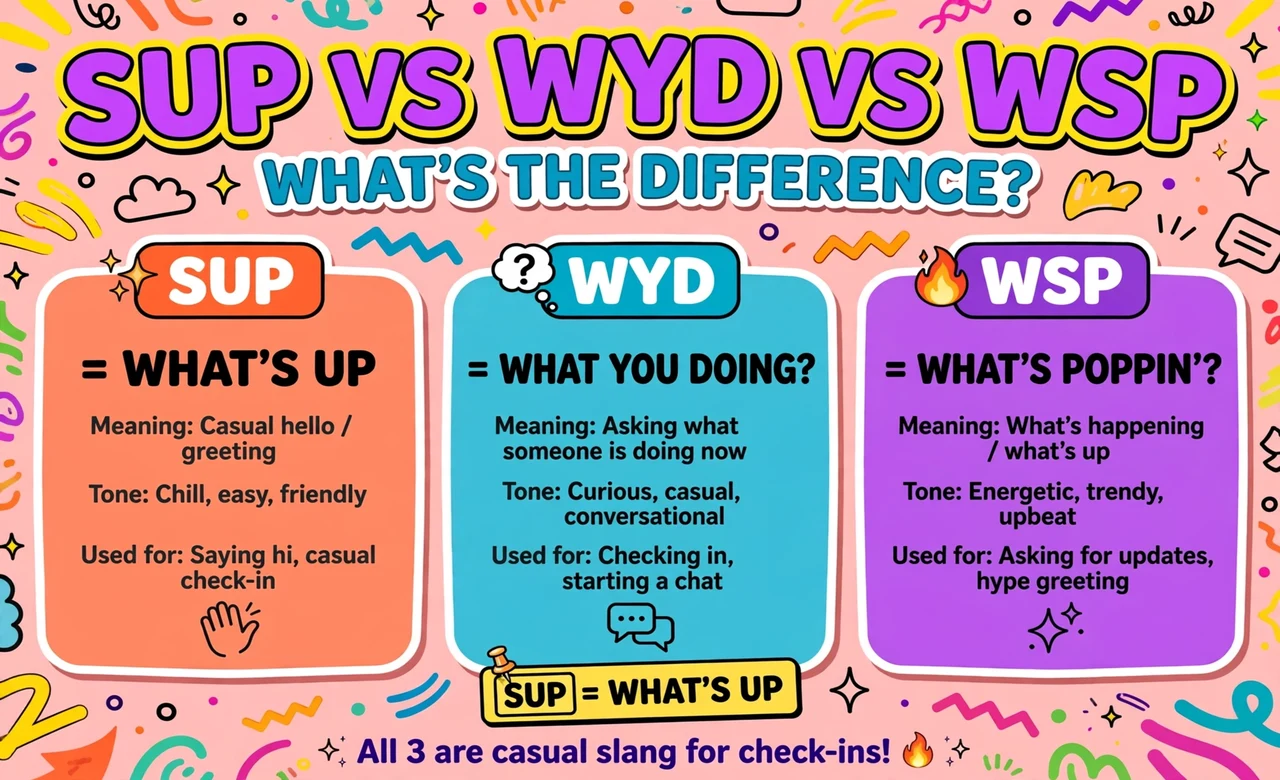
Sup has two close cousins in texting slang: WYD (what you doing) and WSP (what’s up, spelled with a P from “wassup”). All three are casual openers, but they are not identical, and knowing the difference helps you pick the right one.
| SUP | WYD | WSP | |
|---|---|---|---|
| Full form | What’s up | What you doing | Wassup (what’s up) |
| Main job | Greeting | Question about activity | Greeting |
| Feels like | Hello with a smile | “What are you up to right now?” | Hello with extra energy |
| Best reply | A greeting back | A short answer about what you are doing | A greeting back |
| Tone | Casual, friendly | Casual, curious | Casual, playful |
| Common in | Texts, Snapchat, DMs | Texts, Snapchat | Texts, TikTok, DMs |
The practical difference: sup and WSP are greetings, while WYD is a real question. If someone sends “sup,” you can reply “hey” and the conversation is fine. If someone sends “wyd,” they want to know what you are doing, so “hey” alone feels like a dodge, and a short answer like “just chilling, you?” works better. WSP is the playful twin of sup: same meaning, slightly more energy, common in the same places.
In practice, people mix all three freely, and nobody will be confused if you treat them the same. But using the right reply for each one makes your texting feel sharper and more natural.
12 Real Chat Examples of SUP
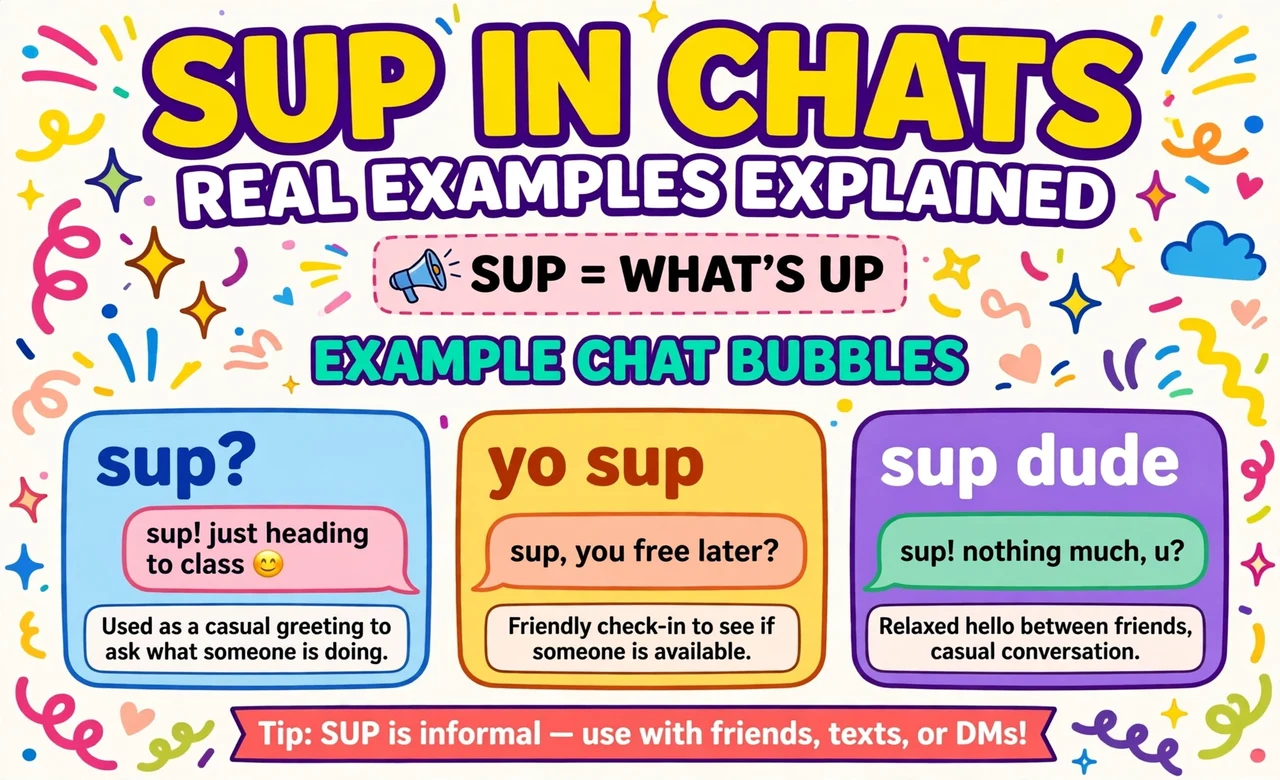
These are realistic examples of sup in real conversations, each with a short note on what is happening.
1. The classic opener
- Alex: sup
- Sam: hey, nm, you?
- Alex: same, just got home
This is the most common sup exchange in the world. A greeting, a greeting back, and the conversation is open. Nothing more is needed.
2. The friendly check in
- Mia: sup, how was your exam?
- Jake: ugh, hard. But I think I passed. You?
- Mia: mine was okay, fingers crossed for both of us
Here sup is a light check in with a real question attached. Jake answers the question and asks back, which keeps the chat balanced.
3. The flirty late night sup
- Ryan: sup
- Emma: hey, why are you up so late?
- Ryan: couldn’t sleep, was thinking of you
The late night timing and the follow up make the tone clear. This sup is a small signal of interest, and Emma reads it correctly.
4. The group chat opener
- Chris: sup everyone
- Lena: hey
- Tom: yo, what’s going on
In a group chat, “sup everyone” is the texting version of walking into a room. Short replies from the group are normal; nobody needs to write a paragraph.
5. The soft start before a favour
- Nora: sup
- Ben: hey
- Nora: so, are you free to help me move on Saturday?
Nora opens with sup to ease in, then asks the real question. Ben should reply to the moving question, not to the greeting.
6. The bored afternoon sup
- Leo: sup
- Ana: hey, nm, bored too?
- Leo: yeah, this day is so slow
Both people recognise the bored sup for what it is. Ana’s playful reply turns it into a real chat.
7. The Snapchat streak sup
- (Snapchat chat) Zoe: sup
- Max: sup, streak day 47!
- Zoe: we are unstoppable
On Snapchat, sup keeps the daily streak chat alive. The streak itself is the context, so the greeting is enough.
8. The Instagram DM sup
- (Instagram DM) Kai: sup, loved your post from the hike
- Ivy: thanks! It was such a good trail
Kai pairs sup with a real comment, which makes the DM feel personal instead of random. This is a good way to use sup with someone you know less well.
9. The TikTok comment sup
- (TikTok comment) sup, this video is so relatable
In a comment, sup is a public friendly shout. It works like a wave to the creator and the other commenters.
10. The gaming lobby sup
- (game lobby) sup, ready to play?
- teammate: yeah, let’s go
This is the greeting meaning in a gaming setting. It is still “what’s up,” not the support role, because the chat is a hello, not a team plan.
11. The gaming role sup
- (team chat) we need a sup for this match
- player: I can play sup
This is the one context dependent meaning: support, the role. The team chat setting is the clear clue.
12. The reply that keeps it going
- Dan: sup
- Eva: hey! Did you see the game last night?
- Dan: yes! That ending was insane
Eva answers the greeting and adds a real topic, which turns a three letter opener into a full conversation. This is the best pattern for replying to sup when you want to talk.
Common Mistakes People Make with SUP
Sup is simple, but a few mistakes show up again and again. Here are the ones to avoid.
Mistake 1: Writing a Long Literal Answer to a Greeting
When someone sends “sup,” they usually want a greeting back, not a paragraph about your day. Replying “Well, I woke up at 7, then I had breakfast, then I went to work” to a casual “sup” feels heavy. Keep it light: “hey, all good, you?”
Mistake 2: Reading Too Much Into the Tone
A plain “sup” with no emoji and no name is usually just a plain greeting, not a cold or angry one. Texting is short by nature. Do not assume a problem unless the rest of the conversation gives you a reason.
Mistake 3: Using SUP in Formal Messages
Sup is casual slang. Do not use it in a job application, a message to a teacher, or a first email to a client. “Hello” or “Hi” is the right choice in formal settings. Sup belongs with friends and casual chats.
Mistake 4: Confusing the Gaming Role with the Greeting
In a normal chat, sup never means support. Only in a gaming team chat about roles does the second meaning appear. If you are not in a game lobby, the meaning is “what’s up,” every time.
Mistake 5: Replying Only “sup” Back Forever
Answering “sup” with “sup” once is normal. Doing it five times in a row stalls the conversation. After the greeting exchange, add a real question or topic to keep the chat moving.
Mistake 6: Sending SUP to Someone You Barely Know Without Context
A bare “sup” from a stranger can feel random or low effort. If you are messaging someone new, pair it with context: “sup, we met at the party last night.” A little context makes the greeting welcome.
When to Use SUP and When Not To
When to Use SUP
Use sup when the setting is casual and friendly:
- Opening a chat with a friend.
- Checking in during the day.
- Starting a conversation on Snapchat, Instagram or TikTok.
- Greeting teammates in a game lobby.
- Keeping a streak or a daily chat alive.
- Replying to a friend’s greeting with a greeting back.
In all of these, sup is natural, warm and correct. It is one of the safest slang words in texting, because its meaning is so settled.
When Not to Use SUP
Skip sup when the setting needs more care:
- Formal messages: job applications, teachers, clients, official emails.
- Serious conversations: bad news, apologies, or sensitive topics deserve real words.
- First messages to strangers with no context: add a line of context so the greeting feels welcome.
- When you need a real answer: if you want to know what someone is doing, “wyd” is clearer than “sup.”
The rule is simple: sup is for casual, friendly moments. When the moment is formal or serious, use full words.
Frequently Asked Questions About SUP Meaning
1. What does sup mean in chat?
Sup means “what’s up.” It is a casual greeting in texting, like hello or hey with a friendly question built in. This is the settled meaning in almost every chat.
2. What does sup mean in texting?
In texting, sup is short for “what’s up.” It works as a greeting, a light check in, or a conversation starter. People have used it this way since long before smartphones, and texting just shortened it to three letters.
3. What does sup mean on Snapchat?
On Snapchat, sup means “what’s up.” It is a common chat opener and story reply, used in the short fast style of Snapchat conversations. The meaning does not change on the app.
4. Is sup short for what’s up?
Yes. Sup is a shortened form of “what’s up,” the spoken greeting. The full phrase shrunk down in casual texting, and the short form kept the same meaning.
5. Is sup a question or a greeting?
It is both, but the greeting part is usually stronger. When someone texts “sup,” a greeting back like “hey” is the most natural reply. The question part is light, like “how are things,” not a demand for a real answer.
6. How do you reply to sup?
Reply with a greeting back (“hey”), a short update plus a question back (“all good, you?”), or answer the real topic if sup came with one. Keep it short and natural.
Conclusion
So what does sup mean? In almost every chat, sup means “what’s up,” a casual and friendly greeting that has been part of everyday language for decades. Whether you see sup meaning in chat on Snapchat, in a text message, in an Instagram DM or in a TikTok comment, the answer is the same: someone is saying hello and opening the door to a conversation.
The full picture is simple to hold in your head. Sup slang is a greeting first, a light check in second, and a conversation starter third. On Snapchat and other apps, it keeps its meaning and just moves faster. In gaming team chats, and only there, sup can mean support, the role, and that context dependent use is easy to spot once you know it exists. Replying is easy too: greet back, give a short update and ask back, or answer the real topic when one follows.
If you searched for sup meaning in texting because a three letter message left you guessing, you can stop guessing now. It is “what’s up,” said the friendly way, and now you know exactly how to read its tone and what to send back. That is the whole skill, and it works in every chat you will ever open.

Hi, I’m Alice, a writer at HubMeanings, where I make confusing words, slang, and phrases easy to understand.
I love exploring language and sharing clear, simple meanings with practical examples.