

You open a chat and there it is, just two little letters: MO. Your friend texts “send mo pics”, a TikTok comment says “post mo”, and someone on Snapchat writes “that is just his MO”. Same two letters, three very different messages. So what does MO mean in text, really? The honest answer is that it depends on the sentence around it, and anyone who tells you MO has only one meaning is skipping half the story.
In everyday texting, MO most often means “more”. It is a short, casual way to ask for extra of something, and it shows up in chats, DMs and comments all over Snapchat, Instagram and TikTok. But in capital letters, MO is also one of the oldest abbreviations in English, short for the Latin phrase modus operandi, which means a person’s usual way of doing things. Add in the British “wait a mo” for “wait a moment”, the US state of Missouri, and a few technical uses, and you have one of the most context dependent slang terms in texting.
This guide breaks down every meaning of MO in text, with the evidence behind each one, real chat examples, and simple rules for telling them apart in seconds. By the end, you will know exactly what MO means on Snapchat, what it means on TikTok, what it means when a girl or a guy sends it, and how to reply without guessing.
Quick Answer: What Does MO Mean in Text?
MO means “more” in most casual texts. When someone writes “mo” in lowercase in a chat, a DM or a comment, they almost always mean “more”. Examples: “I need mo coffee” means “I need more coffee”, and “send mo pics” means “send more pictures”.
MO means “modus operandi” when it is written in capital letters and used about a person. Modus operandi is Latin for “way of operating”, and it describes someone’s usual habit or pattern. Example: “Being late is just his MO” means being late is just his usual habit.
MO means “moment” in British English. “Wait a mo” means “wait a moment”, and “back in a mo” means “back in a moment”.
MO also stands for Missouri, the US state, in addresses and location talk. It is the official two letter postal abbreviation for Missouri, in use since 1963.
So the short version is this: lowercase “mo” in a chat usually means “more”, capital “MO” about a person usually means “modus operandi”, and the rest depends on context. The sections below explain each reading in detail, with sources and strength labels, so you can see exactly how solid each meaning is.
MO Meaning in Text: The Full Picture
MO is a classic example of a word that only makes sense inside its sentence. The two letters can carry at least six different meanings, and the only reliable way to pick the right one is to look at who wrote it, where they wrote it, and what the rest of the sentence says. Here is the full picture, with each reading labelled by how strong its evidence is.
| Reading | What it means | Evidence strength | Main sources |
|---|---|---|---|
| More | Short for “more”, used to ask for extra of something | Very strong, the most common meaning in casual texting | texting.io, fluentslang.com, slangsphere.com, huzzmeaning.com |
| Modus operandi | A person’s usual way of operating, their habit or pattern | Very strong, the most common meaning of capital MO | cyberdefinitions.com, calendar-australia.com, Merriam-Webster (dictionary entry for modus operandi) |
| Moment | A short period of time, as in “wait a mo” | Strong, standard in British English | smileloverz.com, huzzmeaning.com, slangsphere.com |
| Missouri | The US state of Missouri | Very strong, but only in addresses and location talk | USPS state abbreviation list, roadlesstraveledstore.com |
| Money order | A payment certificate bought from a post office or bank | Moderate, common in finance and payment talk | wintercyclingcongress2016.org, oreateai.com |
| Mobile originated | A text message sent from a mobile phone, a telecom term | Moderate, technical use only | Sinch community glossary, Infobip glossary |
| Medical officer / months old | A doctor in charge, or a baby’s age in months | Moderate, medical use only | wintercyclingcongress2016.org, oreateai.com |
| Macao | The ISO country code for Macao | Weak in texting, a code rather than slang | ISO country code list |
Two things stand out from this table. First, the texting world and the abbreviation world disagree about MO. Slang guides aimed at teens and casual texters say “more” first, while abbreviation dictionaries say “modus operandi” first. CyberDefinitions, for example, calls modus operandi the most common definition for MO on Snapchat, WhatsApp, Facebook, Twitter, Instagram and TikTok, while texting.io, FluentSlang and SlangSphere all lead with “more”. Both sides are right, because they are describing different spellings in different settings: lowercase “mo” in a quick chat almost always means “more”, while capital “MO” in a sentence about someone’s behaviour almost always means “modus operandi”. That capitalisation clue is the single most useful trick in this whole guide.
Second, a few readings that people guess are not supported by the sources at all. The most common guess is that MO means “make out”, but none of the slang guides, dictionaries or texting sites we checked list “make out” as a meaning of MO, so do not assume it. If someone writes MO in a flirty chat, they almost certainly mean “more”, as in “miss you mo” or “kiss me mo”, not “make out”. The full list of guesses and mistakes is covered in the Common Mistakes section near the end of this guide.
MO Means “More”: The Most Common Texting Meaning
In casual texting, MO means “more”. This is the reading you will meet most often, and it is the one the slang guides agree on most clearly. Texting.io puts it plainly: the expression “mo” is a shortened version of the word “more”, mainly used by teens and young adults while texting or chatting online. FluentSlang says the same thing, calling MO an abbreviation for “more” that is commonly used by teenagers. SlangSphere calls it “basically a shorthand for more”, and HuzzMeaning describes it as a shorthand expression for “more” or sometimes “moment”, depending on context.
The logic is simple. “More” is already a short word, but in fast thumb typing, even two letters feel like a saving. More importantly, “mo” sounds casual, playful and a little bit cool, which is exactly the tone people want in a chat with friends. Saying “send mo memes” feels lighter than saying “send more memes”, even though both sentences mean the same thing. Texting.io notes that while “mo” and “more” both have one syllable when spoken aloud, using “mo” adds a cool tone to conversations, and that is the real reason people choose it. It is not about saving time. It is about sounding relaxed.
Here is how the “more” meaning shows up in real chats:
- Asking for extra food or drink: “I am still hungry. Let’s get mo tacos.” “Pour mo juice in my glass.”
- Asking for extra pictures or videos: “Can you send me mo pics from the trip?” “That clip was so funny. Post mo.”
- Asking for extra time or fun: “I want mo weekends like this.” “We need mo nights out.”
- Showing a feeling more strongly: “I miss you mo.” “I love this song mo than the last one.”
Notice the pattern in every example. The word “mo” sits exactly where “more” would sit, and if you swap “more” back in, the sentence still makes perfect sense. That swap test is the fastest way to check whether MO means “more” in any message you receive. Read the sentence, replace “mo” with “more”, and if it reads naturally, you have your answer.
The “more” meaning is also the one that travels best across apps. It works the same way in a text message, a Snapchat DM, an Instagram comment, a TikTok reply and a Discord chat. It has no gender attached to it either. Texting.io and FluentSlang both point out that when a girl says “mo”, it means she is asking for more, and when a guy says “mo”, it means exactly the same thing. There is no secret girls only or guys only version of this word, whatever some comment sections claim.
One more detail worth knowing is the spelling with an apostrophe: “mo'”. You will see “mo’ money” and “mo’ problems” written this way in song lyrics and captions, and it means the same thing as “mo”. The apostrophe is a style choice that marks the word as a casual contraction, the same way “gonna” shortens “going to” and “wanna” shortens “want to”. HuzzMeaning notes that “mo'” reflects this kind of casual contraction, and you can treat “mo” and “mo'” as the same word.
MO Means Modus Operandi: The Classic Abbreviation
Now for the other heavyweight meaning. MO, written in capital letters, stands for “modus operandi”, a Latin phrase that translates to “mode of operating” or “way of operating”. It describes the way a person usually does things, their habit, their pattern, their standard approach. When someone says “that is just her MO”, they mean “that is just how she always operates”.
This is the oldest and most established meaning of MO. It comes from law and criminology, where investigators talk about a criminal’s MO, meaning the distinctive pattern in how they commit crimes. The Cambridge Dictionary defines modus operandi as a Latin phrase meaning “mode of operating”, and Calendar Australia explains that it describes a discernible pattern in how a person or group works. From police work, the term spread into business, psychology and everyday speech, and today people use it for anything from a coworker’s meeting habits to a friend’s dating patterns.
Read more:MO Meaning in Text: What Does MO Mean on Snapchat, in Chats and More (2026)
Here are typical examples of the modus operandi meaning:
- “He always texts back three days later. That is just his MO.”
- “Her MO is to stay quiet in the meeting and then send a long email afterwards.”
- “The scammer’s MO is to promise a prize and then ask for a fee.”
- “Being late is his MO. He has never once arrived on time.”
Notice how different this is from the “more” meaning. Here MO is always about a person and their pattern of behaviour. It never sits in the place of the word “more”. The swap test works in reverse: if you replace MO with “more” in “that is just his MO”, you get “that is just his more”, which makes no sense at all. That tells you instantly that you are looking at the modus operandi reading.
Capitalisation is the clearest signal. In practice, “modus operandi” is almost always written as capital MO, while “more” is almost always written as lowercase “mo”. This is not a strict rule, because fast typers ignore capital letters all the time, but it is a strong hint. If you see MO in capitals in the middle of a sentence about someone’s habits, think modus operandi first. If you see “mo” in lowercase in a request, think “more” first.
CyberDefinitions calls modus operandi the most common definition for MO in texting and on apps like TikTok and Instagram, and it lists typical users as adults and teenagers. That ranking surprises a lot of readers, because in a quick chat “mo” for “more” feels far more common. The disagreement is really about which spelling the guide is counting. Abbreviation dictionaries count the capital MO, and slang guides count the lowercase “mo”. Both are right about their own spelling, which is why this guide treats them as two separate meanings instead of forcing one winner.
A short video by creator Andrea Parker on Instagram explains the same idea in plain language: MO is slang short for modus operandi, from Latin meaning “method of operating”, used to describe someone’s way of doing things, habits, routines or strategies. Her examples are “she is always late to meetings, that is just her MO” and “his MO is to stay quiet before speaking up”. If you have ever heard a true crime podcast or a detective show, you have heard this meaning dozens of times, because it is one of the most used Latin phrases in English.
MO Means “Moment”: The British English Reading
The third main reading is “moment”, and it belongs mostly to British English. In the UK, “mo” is a very informal way to say “a moment” or “a short period of time”. The classic phrases are “wait a mo” (wait a moment), “back in a mo” (back in a moment), “hold on a mo” (hold on a moment) and “just a mo” (just a moment). If you text a friend in London and they reply “wait a mo, I am on the phone”, they are not asking for more of anything. They are asking you to wait a moment.
SmileLoverz lists “moment” as one of the core meanings of MO in 2026 slang, with the example “wait mo, I am almost there”. HuzzMeaning also lists “moment” next to “more” as one of the two main slang meanings. SlangSphere mentions it too, noting that besides “more”, “mo” can sometimes pop up as a short form of “moment” in certain contexts. The evidence here is strong but narrower than for “more”, because the “moment” reading is mostly British and mostly spoken. In American texts, “wait a mo” is rare, and most Americans would write “wait a sec” or “one sec” instead.
How do you tell “moment” apart from “more”? Look at the verb next to it. “Wait a mo”, “hold on a mo” and “back in a mo” are time phrases, and they always pair with waiting or returning. “More” pairs with nouns and wants, like “mo pizza”, “mo pics” and “mo time”. If the sentence is about waiting, MO means “moment”. If the sentence is about wanting extra of something, MO means “more”. The swap test works here too: “wait a more” makes no sense, and “I want moment pizza” makes no sense either, so the sentence itself tells you which reading fits.
There is also a related time phrase worth knowing: “in a mo” means “in a moment” or “very soon”. “I will be there in a mo” means “I will be there very soon”. And “for a mo” means “for a moment”, as in “can I borrow your charger for a mo”. These are all British, all casual, and all perfectly normal in everyday UK texting.
One warning about this reading: in American English, “mo” for “moment” can confuse people, because Americans expect “mo” to mean “more”. If you are texting an American friend and you write “wait a mo”, they may read it as a typo or ask what you mean. It is a small thing, but it is the kind of detail that causes real misunderstandings in cross Atlantic chats.
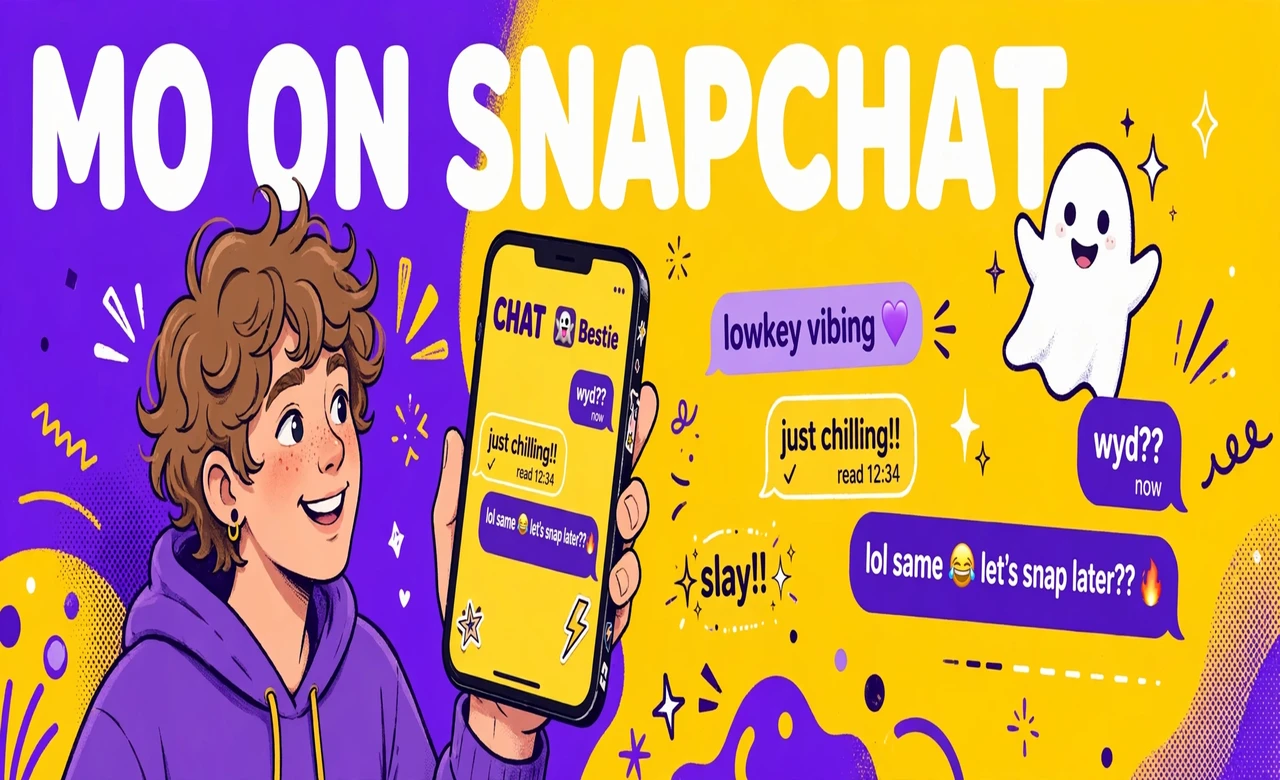
MO on Snapchat
So what does MO mean on Snapchat specifically? The short answer is that Snapchat does not give MO a special meaning of its own. The same three readings apply, and the context of the Snap or chat decides which one you are seeing. That said, each reading shows up in a slightly different way on Snapchat, so here is how to read them on this app.
The most common Snapchat use is “mo” for “more”, usually in a reply to a Story or a Snap. Someone posts a funny video to their Story, and a friend replies “mo pls” or “send mo”. Someone sends a Snap of their food, and the reply is “I need mo of that”. Because Snapchat is fast, visual and casual, the short “mo” fits the pace of the app perfectly. It is the same “more” you see in any text, just delivered inside a Snap reply or a chat bubble.
The second Snapchat use is capital MO for modus operandi, usually in a chat about someone’s behaviour. “He left me on read again, that is literally his MO” is a classic Snapchat complaint. “Her MO is posting a Story and then ignoring all the replies” is another. On Snapchat, where streaks, read receipts and reply times are part of the social game, people talk about each other’s habits a lot, and MO is the word they reach for.
The third Snapchat use is the British “wait a mo”, which shows up when someone is mid conversation and needs a second. “Wait a mo, my mum is calling me” is a normal Snapchat chat message in the UK.
CyberDefinitions says modus operandi is the most common definition for MO on Snapchat, WhatsApp, Facebook, Twitter, Instagram and TikTok. That claim is about the capital MO abbreviation, and it is worth knowing, but in everyday Snapchat chats between friends, the lowercase “mo” for “more” is the one you will see most often. The disagreement between the sources is real, and the honest way to describe it is this: abbreviation dictionaries rank modus operandi first, slang guides rank “more” first, and both are describing real usage. On Snapchat, check the capitalisation and the sentence, and you will almost always know which one it is.
MO on Instagram
On Instagram, MO works the same way as on Snapchat, but the comment section changes the mix a little. Instagram comments are public and short, and that is exactly where “mo” for “more” thrives. Under a Reel of a cute dog, someone comments “mo pls”. Under a travel photo, someone writes “mo pics from this place”. Under a cooking video, the comments say “mo recipes like this”. In each case, “mo” is a quick public request for more of the same content, and it reads as friendly and enthusiastic rather than demanding.
Instagram DMs work like any other chat. In a DM, “mo” means “more” when it is a request (“send mo of those memes”), modus operandi when it is about a habit (“his MO is liking every post and never commenting”), and “moment” when it is about waiting (“wait a mo, checking the link”). The DM setting makes the meaning easier to read, because you know the person and the conversation, while a public comment gives you less context.
One Instagram specific detail is the K-pop usage. The group (G)I-DLE, also written as i-dle, has popularised “M.O.” as a playful term standing for “Motivation” or “My Own” in their fan content, with members Minnie and Yuqi answering fan questions about whether they are “M.O.” This is a niche fandom meaning, not a general Instagram meaning, and it only appears inside that fan community. If you see “M.O.” in a (G)I-DLE fan post, it is probably this playful usage. If you see it anywhere else on Instagram, it is almost certainly “more” or “modus operandi”.
Instagram captions also use “mo” as a style choice. A caption like “mo sunsets like this please” or “mo coffee, mo problems” is playing with the hip hop phrase “mo money mo problems” and using “mo” to sound casual and trendy. The caption is not really asking for anything. It is using the word for its vibe, which is a big part of why slang spreads on Instagram in the first place.
MO on TikTok
TikTok is where the “mo” for “more” meaning is loudest. TikTok comments move fast, and short words win. “Post mo” under a part one video means “post more, I want part two”. “Mo pls” under a funny clip means “more please”. “Explain mo” under a storytime means “explain more”. SmileLoverz notes that on TikTok, “mo” appears in comments like “explain mo”, and HuzzMeaning says TikTok users type “mo” in captions for emphasis or humour. The word fits TikTok’s pace so well that it has become one of the standard comment words, next to “more” itself and “part 2”.
The modus operandi meaning shows up on TikTok too, mostly in storytimes and commentary videos. A creator describing a red flag will say “and that is his MO, he love bombs and then disappears”. A true crime creator will talk about a criminal’s MO. A comedy creator will joke about their own MO, like “my MO is starting a new hobby every Monday and quitting by Wednesday”. In all of these, MO is capital, it is about a pattern, and the swap test with “more” fails completely.
The “moment” reading is rarer on TikTok, because TikTok’s audience is heavily American, and “wait a mo” is a British phrase. You will still see it in comments from UK creators, usually written as “wait a mo” or “one mo”, but it is a small share of TikTok’s MO usage.
There is one more TikTok pattern worth knowing. Because TikTok comments are public and the algorithm rewards engagement, people sometimes comment just “mo” on its own, with no other words. A bare “mo” in a TikTok comment almost always means “more”, as in “I want more of this”. It is the shortest possible way to ask a creator for a follow up video, and creators read it exactly that way.
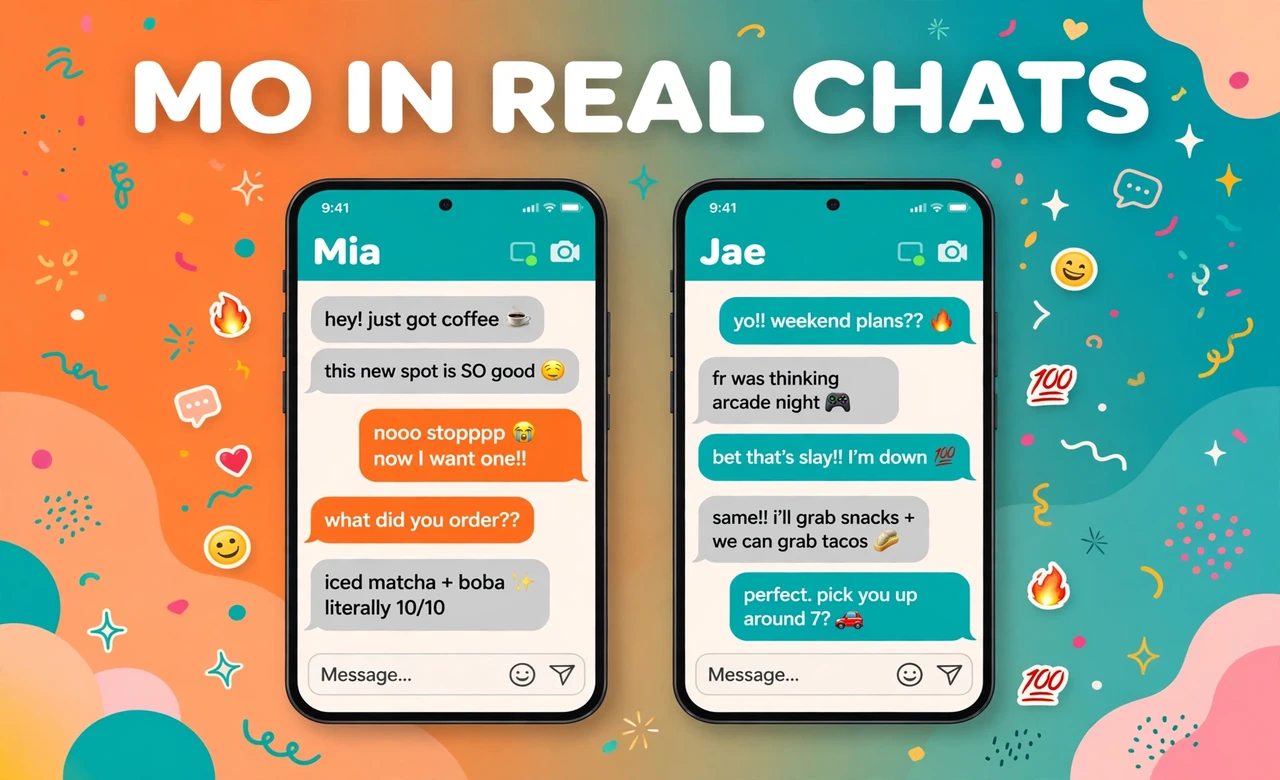
12 Real Chat Examples With MO
Reading about a meaning is one thing. Seeing it in a real chat is another. Here are 12 short example conversations that show MO in action, with the meaning of each one explained right after it. Each example is labelled so you can see exactly which reading is in play.
Example 1: MO means “more” (food)
A: I am still hungry. B: Same. Let’s get mo tacos. A: Yes please, extra cheese this time.
Here “mo” sits where “more” belongs, and the swap test works perfectly. B wants more tacos.
Example 2: MO means “more” (pictures)
A: That sunset photo was unreal. B: Send mo pics from the beach. A: On it, I have like twenty more.
A classic request. “Mo pics” is one of the most common phrases with this word, and it shows up on every app.
Example 3: MO means “more” (time and fun)
A: That trip was the best weekend ever. B: I want mo weekends like this. A: Same. Let’s plan the next one soon.
Texting.io uses a very similar example in its guide, and it shows how “mo” carries a warm, wishing tone, not just a request.
Example 4: MO means “more” (feelings)
A: I can’t wait to see you tomorrow. B: I miss you mo. A: Miss you more. See you at six.
This one confuses people, because “miss you mo” looks odd at first. It means “I miss you more”, with “mo” doing the job of “more” in a playful way.
Example 5: MO means “modus operandi” (a habit)
A: He replied three days later again. B: That is just his MO. He always does this. A: Ugh, you are right. He never changes.
Capital MO, about a person’s pattern. Replace it with “more” and the sentence falls apart, which confirms the modus operandi reading.
Example 6: MO means “modus operandi” (a work habit)
A: She stayed quiet in the whole meeting again. B: That is her MO. Then she sends a five page email at midnight. A: Every single time.
Same pattern. MO describes a repeated way of working, not a quantity.
Example 7: MO means “moment” (British)
A: Can you send me the address? B: Wait a mo, I am on the phone with the driver. A: No rush, take your time.
British English, and the waiting verb gives it away. “Wait a mo” is one of the most used British texting phrases.
Example 8: MO means “moment” (coming back soon)
A: Where did you go? B: Sorry, back in a mo. Had to grab the door. A: All good.
“Back in a mo” means “back in a moment”. It is a promise to return quickly.
Example 9: MO on Snapchat (story reply)
A: (posts a Story of a puppy) B: Omg mo pls, I need more puppy content. A: Haha, he is literally sitting on my lap right now.
Snapchat replies are short and fast, and “mo pls” is a typical Story reaction.
Example 10: MO on TikTok (comment)
Creator: Part 1 of my tiny apartment tour. Commenter: Post mo, I need part 2 right now. Creator: Part 2 is coming tomorrow.
A bare public request for more content. This is the most common TikTok use of the word.
Example 11: MO means Missouri (location)
A: Where are you moving to? B: Kansas City, MO. A: Oh nice, Missouri. I have never been.
Here MO is the official state abbreviation. It is not slang at all, and the context, an address or a location, makes that clear.
Example 12: MO means money order (payment)
A: How do I pay the landlord? He does not take cards. B: Get an MO from the post office. It works like a cheque. A: Got it, I will grab one tomorrow.
A money order is a payment certificate you buy from a post office or a bank. This use is common in renting and in places where people pay without a bank account.
MO Meaning From a Girl
When a girl sends MO, what does it mean? The guides agree: it means the same thing as when anyone else sends it. Texting.io says it plainly, that if a girl says “mo”, it simply means she is asking for more, nothing different from anyone else. FluentSlang says the same, that when a girl uses the term “mo”, it typically means the same thing as when anyone else uses it, and that girls use it to express a desire for more of something or to emphasise their feelings.
In practice, here is what “mo” from a girl usually looks like:
- “I need mo coffee” means she wants more coffee, usually because she is tired or craving it.
- “This dessert is amazing. Mo please!” means she wants another serving.
- “I miss you mo” means she misses you more, with the “mo” adding a playful emphasis to the feeling.
- “We had such a great night” followed by “mo evenings like that would be perfect” means she wants more evenings like that one.
There is no hidden girls only code here. Some articles on the internet try to sell the idea that slang means different things depending on who sends it, but for MO that is not true. The meaning comes from the sentence, not from the sender. A girl saying “mo” in a food chat means “more food”. A girl saying “MO” about a person’s habit means “modus operandi”. The context does the work, not the gender.
The one real difference is tone. In flirty chats, “mo” can carry a soft, teasing tone, as in “kiss me mo” or “stay mo”, where it means “more” but with an affectionate edge. That is still the “more” meaning, just used in a romantic setting. If you are unsure, read the sentence with “more” swapped in. If it makes sense, you have your answer, and you can reply to the request itself instead of worrying about a secret meaning.
MO Meaning From a Guy
The same is true in reverse. When a guy sends MO, it means the same thing as when anyone else sends it. Texting.io says the word has no gender based change in meaning, and that when guys say “mo”, they also mean “more”. FluentSlang agrees, saying that when a guy uses the term “mo”, it generally means the same thing as when anyone else uses it, and that it is an abbreviation for “more” used in casual conversations.
Typical examples from a guy:
- “These wings are fire. Mo, please!” means he wants more wings.
- “I want mo weekends like this” means he wants more weekends like the one you just had.
- “We need mo nights out” means he wants more nights out together.
- “His MO is to stay quiet before speaking up” means his usual habit is staying quiet first, the modus operandi reading.
Guys also use MO in gaming chats and group chats, where it is almost always “more”. “Need mo ammo”, “send mo clips” and “mo games tonight?” are all requests for more of something. In a group chat, a bare “mo” after a funny video means “more of this, please”, and everyone in the group reads it that way.
So if you searched for “mo meaning from a guy” or “mo meaning from a girl” hoping for two different answers, here is the honest one: there is only one set of meanings, and it does not change with the sender. What changes is the sentence around it, and that is where you should always look first.
How to Reply When Someone Sends MO
Replying to MO is easy once you know which meaning you are looking at. Match your reply to the reading, and you will never sound confused.
If MO means “more”, reply to the request. Give them more of what they asked for, or react to it. Examples:
- “Send mo pics” -> “Sending now, check your DMs.”
- “I need mo coffee” -> “Same, I am on my second cup already.”
- “Post mo” -> “Part 2 is coming tomorrow, stay tuned.”
- “I miss you mo” -> “Miss you more. See you soon.”
If MO means “modus operandi”, reply to the habit. Agree, disagree or joke about it. Examples:
- “That is just his MO” -> “You are right, he does it every single time.”
- “Her MO is staying quiet and then emailing” -> “Ha, that is so her. Classic.”
- “My MO is starting hobbies on Monday” -> “And quitting by Wednesday, I know.”
If MO means “moment”, just wait. A short acknowledgement is enough. Examples:
- “Wait a mo” -> “No rush, take your time.”
- “Back in a mo” -> “All good, I will be here.”
If you are not sure which meaning it is, ask a light question. There is no shame in it, because MO is genuinely ambiguous. “Mo as in more, or your MO?” is a normal reply, and most people will laugh and clarify. What you should not do is guess wildly, especially in a serious conversation. A wrong guess about “more” versus “modus operandi” can change the whole tone of a chat, so a one line question is always cheaper than a misunderstanding.
Where Did MO Come From?
MO has two separate origin stories, because it is really two different words that happen to share two letters.
The first story is the Latin one. Modus operandi is a Latin phrase meaning “way of operating”, and it entered English through law and police work centuries ago. It was used to describe the working methods of criminals, and from there it spread into general use for anyone’s usual pattern. The abbreviation MO is simply the first letters of the two Latin words. This is the formal origin, and it is the reason dictionaries list modus operandi first.
The second story is the slang one. “Mo” as a short form of “more” comes from African American Vernacular English and Southern US speech, where clipped words have been common for decades. SlangSphere traces it to AAVE and Southern US slang, and HuzzMeaning notes the same roots. The word then jumped into mainstream culture through hip hop, most famously through The Notorious B.I.G.’s 1997 song “Mo Money Mo Problems”. Texting.io and FluentSlang both credit that song with making the short form visible to a wide audience. The line “mo money, mo problems” turned a piece of street slang into a phrase that almost everyone in English recognises, and from music it moved into texts, captions and comments, where it still lives today.
The British “mo” for “moment” has its own separate history. It is a clipped form of “moment” that has been part of informal British speech for a long time, appearing in phrases like “wait a mo” and “half a mo” (half a moment). It travelled into texting naturally, because people type the way they speak, and British texters type “wait a mo” exactly the way they would say it out loud.
So MO is not one word with one history. It is three histories sharing two letters: Latin law, American hip hop, and British casual speech. That is exactly why it is so confusing, and why the honest answer to “what does MO mean in text” always starts with “it depends”.
MO in Other Contexts: Missouri, Money Order and More
Outside of texting, MO has several meanings that are not slang at all. You will not meet most of these in a chat with friends, but they explain why a search for MO brings up so many different answers, and they matter when the context is not a casual conversation.
Missouri. MO is the official two letter postal abbreviation for the US state of Missouri, home to St. Louis and Kansas City. The US Postal Service introduced the two letter state codes in 1963, when ZIP codes arrived and envelopes needed shorter addresses. Before that, people wrote “Mo.” with a period. Today, “Kansas City, MO” is the standard way to write the address, and “MO” on a form, a map or a location tag almost always means Missouri. It is easy to confuse with MI (Michigan), MS (Mississippi) and MT (Montana), so check the second letter. If the context is an address, a move, a trip or a location, MO means Missouri.
Money order. An MO, or money order, is a payment certificate you buy from a post office, a bank or a store, and the person named on it can cash it on demand. People use money orders when they do not have a bank account, or when a landlord or seller does not trust personal cheques. “I paid with an MO” and “get an MO from the post office” are normal sentences in renting and small business talk. This meaning is common enough that finance guides list it as one of the main meanings of MO.
Mobile originated. In telecom and SMS talk, MO stands for “mobile originated”. An MO message is a text message sent from a mobile phone to an application or a service, the opposite of an MT (mobile terminated) message, which is sent from a service to a phone. The Sinch community glossary defines an MO message as a message sent from a mobile handset to an application, and the Infobip glossary gives the same definition. You will only meet this meaning in technical documents, developer guides and business messaging, never in a chat with friends.
Medical officer. In hospitals, the military and many Commonwealth countries, an MO is a medical officer, meaning a doctor in charge of a department or a unit. “Ask the MO on duty” means “ask the doctor on duty”. This is a professional title, not slang.
Months old. Paediatricians and parents use “mo” as a short form for “months old” when talking about a baby’s age. “She is 6 mo” means “she is six months old”. You will see this on medical forms and in parenting forums.
Macao. MO is also the ISO country code for Macao, the Special Administrative Region of China across the Pearl River Delta from Hong Kong. This is a code used in shipping, domains and international forms, not a word people use in conversation.
None of these meanings competes with “more” or “modus operandi” in a texting context. They matter because they show up in search results and confuse people who are looking for the texting meaning. If you are reading a chat, you can safely ignore all of them. If you are reading a form, an address or a technical document, one of them is probably the right answer.
Common Mistakes About MO
Because MO has so many meanings, people make the same mistakes with it again and again. Here are the most common ones, so you can avoid them.
Mistake 1: Assuming MO means “make out”. This is the most common wrong guess. Some people assume that MO in a flirty chat must mean “make out”, but none of the slang guides, dictionaries or texting sites we checked list “make out” as a meaning of MO. There is no dictionary entry and no page one guide that supports it. If someone writes “kiss me mo” or “miss you mo”, they mean “more”, not “make out”. Do not read a meaning into the word that the sources do not support.
Mistake 2: Ignoring capitalisation. Writing “mo” and “MO” as if they were the same word causes most of the confusion about this term. In practice, lowercase “mo” in a chat almost always means “more”, and capital “MO” about a person almost always means “modus operandi”. Capitalisation is not a perfect rule, because fast typers skip capitals, but it is the best first clue you have, and ignoring it means guessing blind.
Mistake 3: Thinking MO has one settled meaning. Some guides claim MO has a single meaning, and they disagree with each other about which one it is. CyberDefinitions says modus operandi is the most common definition, while texting.io, FluentSlang and SlangSphere say “more” is the main meaning. Both sides are describing real usage, and the honest answer is that MO is unsettled. It has two strong meanings and several smaller ones, and the context decides. Any guide that gives you one meaning and stops there is leaving out half the story.
Mistake 4: Mixing up MO with Montana or Mississippi. MO is Missouri. Montana is MT, and Mississippi is MS. This mix up is common in quizzes and in address forms, and it is the reason the state abbreviation guides always list the three side by side.
Mistake 5: Using MO in formal writing. “Mo” for “more” is casual slang, and it does not belong in a work email, a school essay or a formal message. “Modus operandi” is fine in formal writing, but the short form “MO” is better kept for informal settings unless your reader already knows the term. If you are not sure your reader will understand it, write the full word out.
Mistake 6: Reading an offensive meaning into it. Urban Dictionary lists “mo” as a short form of a slur for a homosexual person, and that usage does exist in some circles. It is rare in ordinary texting, and it is offensive, so it should not be used. If you see “mo” in a normal chat, assume the innocent meaning, “more” or “moment”, unless the sentence gives you a clear reason to think otherwise.
Frequently Asked Questions
1. What does MO mean in text?
In most casual texts, MO means “more”. It is a short, casual way to ask for extra of something, as in “send mo pics” or “I need mo coffee”. In capital letters and in sentences about a person’s habits, MO means “modus operandi”, a Latin phrase for a person’s usual way of doing things. The sentence around it tells you which one applies.
2. What does MO mean on Snapchat?
On Snapchat, MO usually means “more”, most often in a reply to a Story or a Snap, as in “mo pls” under a funny video. It can also mean “modus operandi” in a chat about someone’s behaviour, as in “leaving me on read is just his MO”. Snapchat gives MO no special meaning of its own, so read it the same way you would in any chat.
3. What does MO mean on TikTok?
On TikTok, MO almost always means “more”. Comments like “post mo”, “mo pls” and “explain mo” are requests for more content from a creator. The modus operandi meaning also appears in storytimes and commentary videos, when a creator talks about someone’s pattern of behaviour.
4. What does MO mean on Instagram?
On Instagram, MO means “more” in comments and captions, as in “mo pics from this place” or “mo recipes like this”. In DMs it works like any other chat, and it can also mean “modus operandi” when it describes a person’s habit. In (G)I-DLE fan posts, “M.O.” is sometimes a playful term for “Motivation” or “My Own”, but that is a niche fandom usage.
5. Does MO mean more?
Yes, in casual texting “mo” is short for “more”. Texting.io, FluentSlang, SlangSphere and HuzzMeaning all agree on this, and it is the most common meaning in chats, DMs and comments. If you can replace “mo” with “more” and the sentence still makes sense, then MO means “more” in that message.
6. What does MO stand for?
MO stands for “modus operandi”, a Latin phrase meaning “way of operating” or “mode of operating”. It describes the way a person usually does things, their habit or pattern. Example: “Being late is just his MO” means being late is his usual habit. MO also stands for Missouri, the US state, and for “money order” in finance talk.
7. What is someone’s MO?
Someone’s MO is their usual way of doing things, their habit or pattern. It comes from the Latin phrase modus operandi. If a friend says “her MO is to stay quiet and then send a long email”, they mean that is what she always does. In crime stories, a criminal’s MO is the distinctive pattern in how they commit crimes.
8. What does “wait a mo” mean?
“Wait a mo” means “wait a moment”. It is a British English phrase, and “mo” here is short for “moment”. Related phrases are “back in a mo” (back in a moment), “hold on a mo” (hold on a moment) and “just a mo” (just a moment). This reading is standard in the UK and rare in American texting.
9. Is MO short for Missouri?
Yes, MO is the official two letter postal abbreviation for Missouri, in use since 1963. You will see it in addresses like “St. Louis, MO” and “Kansas City, MO”. It is not slang in this use, and it is easy to confuse with MT (Montana) and MS (Mississippi), so check the second letter.
Conclusion
So what does MO mean in text? The honest answer, after checking the page one guides and the dictionaries, is that it has two strong meanings and the context picks the winner. In a casual chat, a DM or a TikTok comment, lowercase “mo” almost always means “more”, and that is the reading the slang guides like texting.io, FluentSlang and SlangSphere put first.
In a sentence about someone’s habits, capital “MO” almost always means “modus operandi”, the Latin phrase for a person’s way of operating, and that is the reading the abbreviation dictionaries like CyberDefinitions put first. Add in the British “wait a mo” for “moment”, the state of Missouri, the money order and the technical uses, and you have a small word with a surprisingly long list of jobs.
The practical rule is simple, and it fits in one line: swap in “more” and see if the sentence still works. If it does, MO means “more”. If it does not, look at the person the sentence is about, because you are probably looking at modus operandi. If the sentence is about waiting, it is “moment”. And if it is an address, it is Missouri. That one test answers almost every MO message you will ever receive, on Snapchat, on Instagram, on TikTok or in a plain old text.
MO is a good reminder that texting slang is not a fixed code with one answer per word. It is a living language, shaped by hip hop, by British speech, by Latin law and by the speed of thumb typing, all at the same time. The next time MO pops up in your chats, you will not have to guess. You will know what to look for, what it probably means, and how to reply. And if you ever meet a new piece of slang that confuses you the same way, the same method works: check the sentence, check the capitalisation, and check the sources before you settle on one meaning.

Hi, I’m Alice, a writer at HubMeanings, where I make confusing words, slang, and phrases easy to understand.
I love exploring language and sharing clear, simple meanings with practical examples.