

If you have ever opened a chat and seen the three letters HBU sitting at the end of a message, you are not alone. It shows up in text messages, in Snapchat chats, in Instagram DMs, in TikTok comments and in WhatsApp group chats, and it always seems to arrive right after someone has just told you something about themselves. A friend writes “I am doing great today, hbu?” and suddenly the ball is in your court. A crush replies “Good, hbu?” and you need to answer fast. A classmate drops “Finished my homework, hbu?” in the group chat HBU Meaning in Text: What Does HBU Mean on Snapchat, in Chats and More (2026) and everyone knows exactly what it means.
HBU is one of the most common texting abbreviations in English, and it is also one of the simplest. It stands for “how about you” and it does exactly one job: it hands a question back to the other person. Someone answers a question, shares an update or states an opinion, and then adds HBU to ask for yours in return. That small habit is what keeps casual conversations flowing, and it is the reason HBU has survived from the early days of instant messaging all the way to the Snapchat and TikTok era.
Quick Answer Box
HBU means “how about you” in texting.
It is a short, casual way to return a question to the person you are talking to. When someone says “I am good, hbu?”, they are really saying “I am good. How about you?” You will see HBU on Snapchat, Instagram, TikTok, WhatsApp and in plain text messages, and it means the same thing on every app. It is informal, friendly and meant only for casual conversations, never for formal emails, exams or job interviews.
What Does HBU Mean in Text?
HBU stands for “how about you” and it works like a mirror in a conversation. One person shares something, and HBU bounces the same question straight back. Here is the pattern in its simplest form:
Person A: “How are you doing?” Person B: “I am doing great, hbu?”
Person B answered the question and then used HBU to ask Person A the very same thing. That is the whole trick. HBU saves time, keeps the chat moving and shows the other person that you care about their answer too. Without it, a conversation can feel one sided, like an interview where only one person is ever asked anything. With it, the chat feels balanced and natural.
The reason HBU is so popular is that it packs a full sentence into three letters. Typing “how about you” takes seven letters plus spaces. Typing “hbu” takes three keystrokes. In fast chats, especially on Snapchat where messages disappear and speed matters, that saving adds up. Teenagers, college students and young adults use HBU dozens of times a week, often without even thinking about it, because it has become a reflex of digital conversation.
HBU also carries a friendly tone. It is not a cold or formal question. It sounds warm, casual and interested, which is why it works so well between friends, classmates, siblings and even people who are just getting to know each other. When someone adds HBU to a message, they are usually saying two things at once: here is my answer, and I genuinely want to hear yours.
One thing that makes HBU easy to understand is that its meaning does not change with context. Unlike some slang terms that mean one thing on Snapchat and something else on TikTok, HBU means “how about you” everywhere. The app changes, the people change, the topic changes, but HBU stays the same. That consistency is rare in internet slang, and it is a big reason why HBU has stayed in use for more than twenty years while other abbreviations have faded away.
HBU Full Form and Pronunciation
The full form of HBU is “How About You” and each letter comes from the first letter of each word: H for How, B for About (or “Bout” in the relaxed spoken version), and U for You. You will sometimes see it written as “How ‘Bout You” because that is how the phrase sounds when people say it quickly in American English. “How about you” slides into “how ’bout you” in natural speech, and HBU captures that relaxed pronunciation in three letters. Both spellings mean exactly the same thing, so you can use either one when you write the full form out.
HBU is pronounced letter by letter: “H B U” (aych bee yoo). Nobody says it as a single word. In a voice note or a real life conversation, a person would say the full phrase “how about you” instead, because saying the letters out loud sounds odd. HBU belongs to typed chats, not spoken conversation, and that is true of most texting slang.
You will usually see HBU written in lowercase as “hbu” in casual chats. Lowercase feels more relaxed and it matches the way people type quickly on their phones. Uppercase “HBU” is also correct and it is more common at the start of a sentence or when someone wants to add a little emphasis. There is no rule that says one is right and the other is wrong, so use whichever fits the flow of your chat. Just remember that writing HBU in all caps with an exclamation mark, like “HBU?!”, can make it look like you are impatient, so save the caps for moments when you really mean it.
Two close relatives of HBU are worth knowing because they show up in the same chats. HBY stands for “How ‘Bout You” and it means exactly the same thing as HBU, just spelled with a Y instead of a U at the end. WBU stands for “What About You” and it also means the same thing in practice, though it starts with “what” instead of “how”. You will learn the small differences between these three in the comparison section later in this article.
Where Did HBU Come From?
HBU was born in the early days of internet chat, when typing speed mattered more than spelling. In the late 1990s and early 2000s, people spent hours in AOL Instant Messenger chats, MSN Messenger windows and early mobile text messages, and every character cost time or money. Text messages had strict character limits, and early phone keypads made typing slow and painful. Abbreviations like LOL, BRB, OMG and HBU were the solution: they let people say more with fewer keystrokes.
According to Urban Dictionary, the entry for “hbu” dates back to 2004, with one popular entry tracing the acronym to an AOL Instant Messenger conversation in early 2004. Other slang dictionaries place its first definitions around the same period. By the mid 2000s, when unlimited texting plans became common in the United States around 2005 to 2008, HBU had already spread from chat rooms into everyday texting. It was one of the first abbreviations that teenagers taught their parents, and one of the few that parents actually started using themselves.
The rise of social media gave HBU its second big push. Facebook, Twitter, Instagram and Snapchat all rewarded short, fast messages, and HBU fit perfectly. On Snapchat in particular, where messages vanish and streaks depend on daily back and forth, HBU became a daily habit. A quick photo with the caption “Chilling at home, hbu?” kept a streak alive and kept a friendship warm, all in five words. TikTok comments later gave HBU a third home, where creators and fans use it to turn a one way video into a two way conversation.
What is remarkable is how little HBU has changed in twenty years. Many slang terms from the early 2000s are now dead or embarrassing to use, but HBU still sounds current in 2026. The reason is simple: the thing it does, returning a question politely, is a basic part of human conversation. As long as people chat online, they will need a fast way to say “how about you”, and HBU is the fastest way to say it.
HBU Meaning on Snapchat
On Snapchat, HBU means “how about you”, exactly the same as it means anywhere else. What makes Snapchat special is how often HBU shows up there and why it fits the app so well. Snapchat is built for quick, casual, disappearing messages, and HBU is built for quick, casual, disappearing conversations. The two were made for each other.
The most common place you will see HBU on Snapchat is in streak chats. A streak is a run of consecutive days where two friends send each other at least one snap, and keeping a streak alive takes daily effort. Nobody has time to write a paragraph every day, so friends send short snaps with captions like “Good morning, hbu?” or “Bored at home, hbu?” These tiny messages do two jobs at once: they keep the streak going and they keep the friendship warm. HBU turns a one word snap into a real conversation starter, even if the whole conversation is only four messages long.
HBU also appears in Snapchat photo captions. Someone posts a snap of their lunch, their outfit or their dog, and adds “Lunch time, hbu?” as the caption. The photo shares their moment and HBU invites the viewer to share theirs. It is a small invitation that makes a one way photo feel like a two way chat. The same trick works on Snapchat Stories, where a creator can post a question sticker or a caption ending in HBU to pull replies out of people who would otherwise just watch and scroll past.
Another Snapchat habit worth knowing is the “streaks” reply. When someone sends you a snap just to keep the streak alive, a common reply is a photo of your ceiling or your lunch with the text “nm, hbu?” That stands for “not much, how about you?” and it is the laziest, friendliest reply in the Snapchat universe. It says: I do not have much news, but I am still here, and I still want to hear from you. If you get “nm, hbu?” from someone, do not read it as rude. It is Snapchat shorthand for “I care, but I am busy”.
Here are the typical ways HBU appears on Snapchat:
- As a streak keeper: “Morning, hbu?”
- As a photo caption: “At the beach, hbu?”
- As a reply to a snap: “Same, hbu?”
- As a check in after a few days: “Long time no snap, hbu?”
- As a low effort reply: “nm hbu?”
If you are new to Snapchat and you keep seeing HBU, now you know it is just a friendly question, not a test. Reply with your own update and add HBU back, and the conversation will roll on by itself.

HBU Meaning on Instagram
On Instagram, HBU means “how about you” and it lives mostly in DMs and comments. Instagram is a more visual app than Snapchat, so HBU often appears right after a reaction to a photo or a reel. A friend comments on your post with “Love this outfit, hbu?” and they are really saying two things: I like your photo, and now tell me something about you. That mix of compliment and question is very Instagram, and HBU is the shortcut that makes it fit in a comment.
In Instagram DMs, HBU works the same way it works in any chat. Someone replies to your story with “That looks fun, hbu?” or answers your question and adds HBU at the end. Because Instagram DMs support long messages, voice notes and reels, HBU often shows up in the middle of longer conversations, not just in one line chats. A friend might send you a reel, write a paragraph about their day, and finish with “hbu?” to hand the conversation back to you. The longer the message, the more HBU matters, because without it the chat can turn into a monologue.
HBU also shows up in Instagram story replies and question stickers. A creator posts a story asking “What are you doing today?” and followers reply with their plans plus HBU. A business or influencer account might post a poll or a question box and get “Good, hbu?” as a reply. In all of these cases, HBU is doing the same job: it turns a broadcast into a conversation and it tells the other person that their answer matters.
One Instagram specific habit is the “hbu” comment on a close friend’s post. When someone you know well posts a photo, commenting “hbu?” under it is a playful way to say “I see you, now talk to me”. It is more personal than a like and less formal than a full comment. If you see HBU in your Instagram comments, take it as a good sign: someone is not just scrolling past your content, they actually want to chat with you.
HBU Meaning on TikTok
On TikTok, HBU means “how about you” and it appears most often in comments and in direct messages. TikTok is a video first app, so HBU usually follows a reaction to a video rather than starting a conversation from scratch. Someone watches a video about a morning routine, a recipe or a travel vlog, and comments “I do the same thing, hbu?” That comment does something clever: it agrees with the creator, shares a personal detail, and then asks everyone else to join in. A single HBU in a TikTok comment can start a whole thread of replies.
Creators use HBU in their videos too. A TikToker might end a video with “I am spending my weekend at home, hbu?” and the comment section fills up with answers. This is a deliberate engagement trick, and it works because HBU feels personal. It does not feel like a formal survey question. It feels like a friend asking you directly, and people answer it the same way they would answer a friend.
In TikTok DMs, HBU behaves like it does in any other chat app. Friends who met through TikTok use it to keep conversations going after they start talking about a video. Someone sends you a TikTok, you react to it, and then one of you adds HBU to move the chat from the video to real life. That move from content to conversation is where friendships on TikTok actually begin, and HBU is often the bridge.
There is one TikTok habit that confuses people: HBU in a comment that seems to come out of nowhere. If you post a video and a stranger comments “hbu?”, they are usually not asking about the video at all. They are opening a conversation with you, the same way someone might say “hey” in real life. You are free to answer, ignore it or reply with a simple “good, you?” depending on how you feel. HBU from a stranger is almost always friendly, but you never owe a stranger a reply.
HBU Meaning in Texting and WhatsApp
In plain texting and on WhatsApp, HBU means “how about you” and it is probably where most people first meet it. Texting is the oldest home of HBU, older than Snapchat, Instagram or TikTok, and the rules there are the simplest. You answer a question, you add HBU, and the other person answers back. That is the whole system, and it has worked for twenty years.
On WhatsApp, HBU is common in both one to one chats and group chats. In a one to one chat, it works exactly like texting: “I am good, hbu?” In a group chat, HBU can be aimed at one person or at the whole group. If someone writes “I finished my exams, hbu guys?” in a group, they are asking everyone in the group to share their own update. Group chat HBU is a great way to wake up a quiet group, because it gives everyone a clear reason to reply.
HBU also pairs with other abbreviations in texting, and the most famous pair is “nm hbu”, which means “not much, how about you?” You will see “nm hbu” so often that it almost counts as a single phrase. It is the standard reply when you do not have big news but you still want to keep talking. Other common pairs include “good hbu” (I am good, how about you?), “same hbu” (same here, how about you?) and “bored hbu” (I am bored, how about you?). Each of these follows the same pattern: a short update, then HBU to hand the question back.
The tone of HBU in texting is warm and casual, but it can also feel lazy if it is used too much. If every message in a conversation ends with HBU and nothing else, the chat starts to feel like a tennis match with no real rallies. The fix is simple: share something real before you add HBU. Instead of “good, hbu?” try “good, just finished a great book, hbu?” That one extra detail gives the other person something to respond to, and the conversation gets much better.
12 Real Chat Examples of HBU
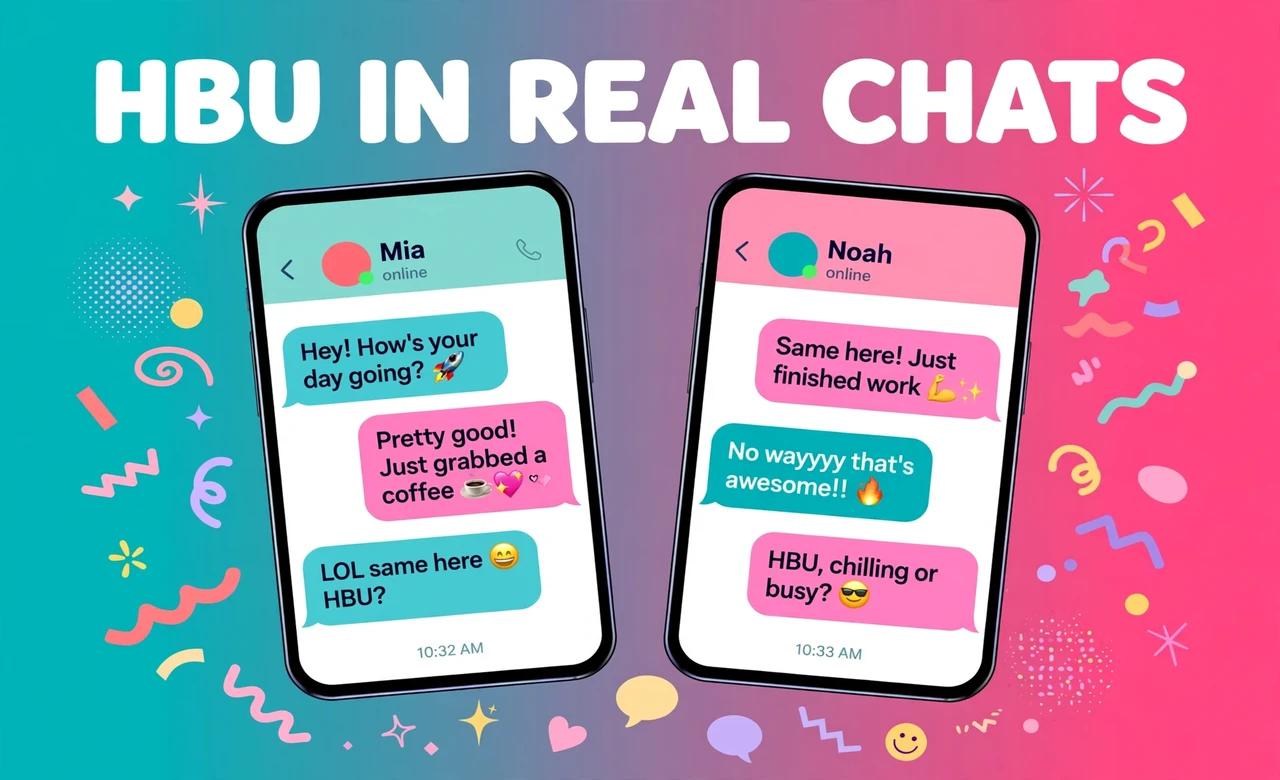
The best way to understand HBU is to see it in real conversations. Here are 14 short chat examples that show how people actually use it, with a note under each one explaining what is happening. Read them in order and you will see the pattern: share something, add HBU, get an answer back.
Example 1: The classic greeting
A: Hey, how are you? B: I am doing great, hbu? A: I am good too, just finished work.
This is the most common HBU exchange in the world. B answers the question and returns it in the same message.
Example 2: The morning check in
A: Good morning! What are you up to today? B: Morning! Just having coffee, hbu? A: Same, then I have class at 10.
HBU turns a morning greeting into a real conversation about the day ahead.
Example 3: The weekend plan
A: My weekend was amazing, I went hiking. Hbu? B: Nice! Mine was quiet, just stayed home and watched movies.
Here HBU comes first in the sentence, which is also fine. A shares their weekend and asks about B’s in one breath.
Example 4: The Snapchat streak
A: (sends a photo of lunch) Lunch time, hbu? B: (sends a photo of their lunch) Same, just eating now.
On Snapchat, HBU often travels with a photo, and the reply is often another photo.
Example 5: The bored texter
A: I am so bored right now, hbu? B: Same, want to play a game online?
HBU is perfect for boredom because it invites the other person to suggest something better.
Example 6: The exam stress
A: I just finished my exams, finally free! Hbu? B: Lucky you, I still have two more to go.
HBU works for good news and bad news alike. It just asks for the other side of the story.
Example 7: The food chat
A: I made pasta for dinner, it was so good. Hbu? B: I ordered pizza, too tired to cook.
Food is one of the most common HBU topics because everyone eats and everyone has an opinion about it.
Example 8: The “nm hbu” reply
A: What are you doing? B: Nm, hbu? A: Just watching a show, you should join me.
“Nm hbu” means “not much, how about you?” and it is the most used HBU phrase in texting.
Example 9: The Instagram comment
A: (comments on a photo) Love this outfit! Hbu? B: (replies) Thank you! I am doing great, what about you?
In comments, HBU turns a compliment into a conversation starter.
Example 10: The TikTok reply
A: (comments on a video) I do the same thing every morning, hbu? B: Same! I thought I was the only one.
On TikTok, HBU invites the whole comment section to join in, not just the creator.
Example 11: The group chat wake up
A: I am free this Saturday, hbu guys? B: I am free too! C: Same here, let us plan something.
In a group chat, HBU with “guys” at the end asks the whole group at once.
Example 12: The crush conversation
A: I had a really good day today, hbu? B: Mine was good too, what made yours so good?
When a crush sends HBU, it is a green light. They are interested and they want the conversation to continue.
Example 13: The late night chat
A: Can’t sleep, hbu? B: Same, I have been scrolling for an hour.
Late night HBU is often an invitation to talk until both people get sleepy.
Example 14: The catch up after a long time
A: Hey, long time no talk! I moved to a new city last month, hbu? B: Wow, congrats! I am still here, same job, same life.
After a long gap, HBU helps two people swap life updates quickly and warmly.
How to Reply to HBU
Replying to HBU is easy, but replying well takes one small extra step. The basic reply is simple: answer the question, then ask it back. But the best replies add a detail that gives the other person something to respond to. Here are the reply styles that work, from simplest to best.
The simple reply. Just answer and return the question. “I am good, hbu?” or “Not much, hbu?” These are fine for quick chats and streaks, and nobody will judge you for using them. They are the bread and butter of HBU replies.
The detailed reply. Add one real detail before you return the question. “I am good, just got back from the gym, hbu?” or “Not much, just finished a great book, hbu?” That detail turns a dead end chat into a real conversation, because now the other person can ask about the gym or the book.
The funny reply. If the mood is light, a joke works well. “I am alive, hbu?” or “Surviving Monday, hbu?” These replies keep the tone playful and they are perfect for friends who like to joke around.
The honest reply. If you are having a bad day, you do not have to fake it. “Honestly, not great today, hbu?” is a brave and honest answer, and it lets the other person support you. HBU is an invitation to be real, not just to be polite.
The flirty reply. If you like the person, HBU is your chance to keep the conversation going. “Better now that you texted, hbu?” or “Good, but my day would be better with you in it, hbu?” These are bold, so save them for someone you know well.
What not to reply. Avoid one word answers with no HBU back, like just “good” or “fine”, because they can kill the conversation. If someone asks you HBU and you reply with a single word and nothing else, they may think you are busy or not interested. Even a short “good, you?” keeps the door open. Also avoid answering with a question that ignores theirs, like replying “hbu?” to “hbu?” without ever answering. That just bounces the ball back and forth without anyone actually saying anything.
HBU vs WBU vs HBY: What Is the Difference?
HBU, WBU and HBY look almost identical and they mean almost the same thing, which is why people mix them up. Here is a clear comparison so you never confuse them again.
| Abbreviation | Full Form | Meaning | How Common |
|---|---|---|---|
| HBU | How About You | How about you? | Very common, the standard choice |
| WBU | What About You | What about you? | Very common, used the same way as HBU |
| HBY | How Bout You | How ’bout you? | Less common, a shorter spelling of HBU |
In real conversations, HBU and WBU are interchangeable. “I am good, hbu?” and “I am good, wbu?” mean the same thing and nobody will notice which one you used. The only real difference is the first word: “how” versus “what”. “How about you?” asks about your state or situation, while “what about you?” asks about your opinion or your side of things, but in casual texting that difference disappears completely. Use whichever one feels natural to you.
HBY is simply a different spelling of HBU. It stands for “How ‘Bout You” and it drops the U in favor of a Y, because “bout you” sounds like “bout ya” when people say it fast. HBY is less common than HBU, and some people have never seen it, so HBU is the safer choice if you want to be understood by everyone. If someone sends you HBY, just read it as HBU and reply the same way.
There is also HAY, which stands for “How Are You” and is sometimes used as another way to write “how about you”. HAY is rare and it can be confused with the word “hay”, so most people stick with HBU. The safest rule is simple: when in doubt, use HBU. It is the most recognized, the most used and the least likely to confuse anyone.
What Does HBU Mean from a Girl?
When a girl sends you HBU, it means “how about you” and nothing more complicated than that. She answered your question and she is asking it back. That is the whole meaning, and it is the same meaning it has from anyone else. But the context around it can tell you a little more about what she is feeling.
If a girl sends HBU quickly after you text her, it is a good sign. It means she is engaged in the conversation and she wants it to continue. A girl who is not interested usually gives short replies with no question back. A girl who adds HBU is doing the opposite: she is opening the door for you to keep talking. She is not just answering you, she is inviting you to share more.
If a girl sends HBU after a compliment or a sweet message, it often means she liked what you said and she wants to keep the warm feeling going. For example, if you say “You look great today” and she replies “Thank you! Hbu?”, she is accepting the compliment and turning the attention back to you. That is a friendly and open response, and the best reply is to share something real about your day.
There is one myth worth clearing up: HBU from a girl does not secretly mean she likes you. It means she is being polite and friendly, which is what most people do in most chats. It can be a sign of interest, but only when it comes with other signs, like fast replies, questions about your life, laughing at your jokes and starting conversations herself. HBU alone is not a confession of feelings. It is just good conversation, and the smartest move is to answer it well and see where the chat goes.
What Does HBU Mean from a Guy?
When a guy sends you HBU, it means “how about you”, exactly the same as it means from anyone else. He answered your question and he is asking it back. The meaning does not change with gender, and there is no secret male code hidden inside those three letters.
That said, the context can add a little color. If a guy sends HBU in the middle of a fun, fast conversation, it usually means he is enjoying the chat and he wants it to keep going. Guys who are bored or uninterested tend to reply with one word and no question. A guy who adds HBU is putting in effort, even if it is only three letters of effort, and that effort counts.
If a guy sends HBU after you share something personal, like a bad day or a big win, it is often his way of showing support without writing a long emotional message. Many guys are not comfortable writing paragraphs about feelings, so HBU is their shortcut to saying “I heard you, and now I want to hear more”. It is a small gesture, but it is a real one.
The same myth applies here as with girls: HBU from a guy does not automatically mean he likes you romantically. It means he is being friendly and he wants the conversation to continue. If he also texts you first, remembers details about your life and makes time to talk to you, then the interest is probably real. But HBU by itself is just a friendly question, and the best response is to answer it honestly and see what happens next.
Other Meanings of HBU You Should Know
In texting and social media, HBU almost always means “how about you”. But the same three letters can mean other things in other worlds, and it is worth knowing them so you are never confused if you see HBU outside a chat.
Houston Baptist University. The most common non texting meaning of HBU is Houston Baptist University, a private Christian university in Houston, Texas. The university has since changed its name to Houston Christian University, but many people, alumni and older websites still use HBU. If you see HBU on a college website, a degree or a sports page, it almost certainly means the university, not “how about you”. Context makes it obvious: nobody writes “I graduated from How About You in 2019”.
Help Build Unity. In a few niche online communities, HBU has been used to mean “Help Build Unity”, usually as a slogan or a group name. This usage is very rare and you are unlikely to meet it in a normal chat. If someone uses HBU this way, they will usually explain it, because they know most people will read it as “how about you” first.
Joke entries on Urban Dictionary. Urban Dictionary is written by users, and some of its HBU entries are jokes rather than real definitions. One popular joke entry claims HBU means “horny boy up”, which is not a real meaning and is not used by anyone in normal conversation. It is a prank definition written to make people laugh, and it is a good reminder that Urban Dictionary entries are not all trustworthy. The top voted and most repeated definition on Urban Dictionary is “how about you”, and every serious slang dictionary agrees with it.
HBU in business and tech. In business, HBU can stand for “Highest and Best Use”, a term used in real estate to describe the most profitable legal use of a piece of land. In tech, it can appear as an abbreviation for a product name or a department. These meanings only appear in professional documents, never in a chat with a friend. If you are texting, HBU means “how about you”. If you are reading a property report, it means something else, and the document will make that clear.
The rule is simple: in any chat, comment, DM or text message, HBU means “how about you”. The other meanings exist, but they live in completely different worlds, and the context will always tell you which one you are looking at.
Read more:EVB Meaning in Text
When Not to Use HBU
HBU is a great tool, but it is not right for every situation. Using it in the wrong place can make you look careless or unprofessional, so here are the moments when you should write the full phrase or skip it entirely.
Formal emails and work messages. Never use HBU in a job application, a work email or a message to your boss. Write “how about you?” in full, or better yet, write a complete professional sentence. Slang in a formal email tells the reader that you did not take the message seriously, and that is a bad first impression.
Exams and school assignments. HBU has no place in schoolwork. Teachers expect full English in essays and assignments, and slang abbreviations can cost you marks. Save HBU for your friends, not your homework.
Serious or sad conversations. If someone is telling you about a loss, an illness or a difficult time, replying with a quick “hbu?” can feel cold. In serious moments, people need real words, not shortcuts. Take the time to write a full, caring reply instead.
The first message to a stranger. Opening a conversation with a stranger by writing only “hbu?” can feel random or pushy. If you are messaging someone for the first time, introduce yourself and give them a reason to reply. HBU works best after a conversation has already started, not as the very first word.
When you have already used it three times in a row. If every message in a chat ends with HBU, the conversation starts to feel like a loop. Mix it up with real questions: “What did you think of the movie?” or “How was your meeting?” Real questions get real answers, and real answers make better conversations than endless HBU volleys.
Frequently Asked Questions
1. What does HBU mean in text?
HBU means “how about you” in texting. It is used to return a question to the other person after answering it yourself. For example, “I am good, hbu?” means “I am good. How about you?”
2. What does HBU mean on Snapchat?
On Snapchat, HBU means “how about you”, the same as anywhere else. It is very common in streak chats, photo captions and quick replies, where friends use it to keep conversations going with very few words.
3. What does HBU mean on Instagram?
On Instagram, HBU means “how about you”. It appears in DMs and in comments, often after a reaction to a photo or a reel, as a way to turn a compliment or a reaction into a conversation.
4. What does HBU mean on TikTok?
On TikTok, HBU means “how about you”. It shows up in comments under videos and in DMs, where people use it to agree with a creator and invite others to share their own experience.
5. What is the full form of HBU?
The full form of HBU is “How About You”. It is also written as “How ‘Bout You”, which is how the phrase sounds when people say it quickly in American English.
6. How do you reply to HBU?
Answer the question first, then ask it back. The simplest reply is “I am good, hbu?” A better reply adds a detail, like “I am good, just got back from the gym, hbu?” That detail gives the other person something real to respond to.
7. What does “nm hbu” mean?
“Nm hbu” means “not much, how about you?” NM stands for “not much”. It is the standard reply when you do not have big news but you still want to keep the conversation going.
8. What does HBU mean from a girl?
When a girl sends HBU, it means “how about you”. She answered your question and she is asking it back. It is a friendly sign that she wants the conversation to continue, but by itself it is not proof of romantic interest.
9. What does HBU mean from a guy?
When a guy sends HBU, it means “how about you”. He answered your question and he is asking it back. It is a friendly sign that he is engaged in the conversation and wants it to continue.
Conclusion
HBU is a small abbreviation with a big job. It stands for “how about you”, and it does the simple, human work of turning a one sided message into a real conversation. Someone shares an update, adds HBU, and suddenly two people are talking instead of one person reporting. That is why HBU has survived from the AOL Instant Messenger era all the way to Snapchat streaks, Instagram DMs and TikTok comments, and why it still feels current in 2026 when so many other abbreviations have faded away.
The meaning of HBU is settled and simple. Every major slang guide, dictionary and texting resource agrees: HBU means “how about you”. It means the same thing on Snapchat, Instagram, TikTok, WhatsApp and in plain text messages, and it means the same thing whether it comes from a girl, a guy, a friend or a stranger. There are no hidden meanings in a normal chat, and there is no trick to it. If someone writes HBU, they want to hear about you.
The next time you see HBU in your chats, you will know exactly what to do. Answer honestly, add a small detail about your day, and send the question back. That is the whole secret of HBU, and it is also the whole secret of good conversation: share something real, and then ask the other person to do the same. HBU is just the fastest way to say it.

Hi, I’m Alice, a writer at HubMeanings, where I make confusing words, slang, and phrases easy to understand.
I love exploring language and sharing clear, simple meanings with practical examples.