
Have you ever opened a message that just says “OFC” and paused for a second, unsure whether it means yes, maybe, or something else entirely? Or have you seen OFC in a Snapchat chat, a TikTok comment, or a group text, and wondered whether it is agreement, sarcasm, or a completely different word? If you have searched for ofc meaning in text, or typed what does ofc mean into Google, this guide will give you a clear, honest answer, and it will also show you something most guides skip: OFC has a tone problem, because it can sound warm and friendly in one message and sarcastic in the next.
Here is the honest starting point, and it is good news: OFC has one settled texting meaning. OFC means Of Course. It is a quick, casual way to say yes, obviously, definitely, or naturally. In almost every chat, on almost every app, that is what OFC means, and the rest of this guide will show you how to read its tone, how to reply to it, and when a different reading might fit instead.
The ofc meaning on snapchat is the reason most people search for this term today. Snapchat chats move fast, and short replies are the norm. When a friend asks “Are you coming to the party?” and the reply is just “OFC,” that is not a mystery or a riddle. It is Of Course, said in the fastest way possible. That one example covers most of what you will ever see, and the rest of this guide fills in the detail around it.
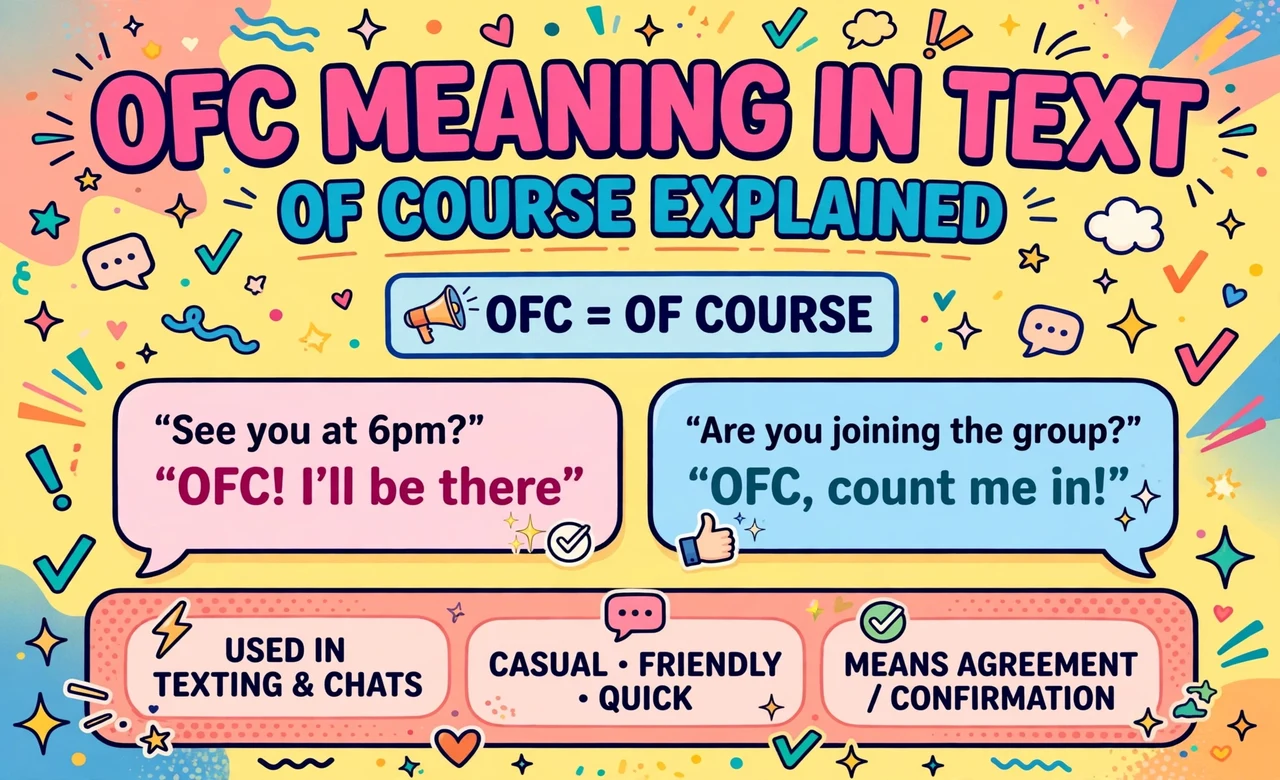
OFC Meaning in Text: Quick Answer
OFC means Of Course.
It is a short, casual way to say yes, obviously, definitely, or naturally. This is the settled texting meaning, and it is the meaning you should assume first in almost every chat.
For example:
- “Are you coming tonight?” “OFC.”
- “OFC, that movie was so good.”
- “Can you send me the notes?” “OFC, I will send them now.”
In each example, OFC works like a fast yes with a little extra confidence. It agrees, confirms, or emphasises the message around it, and it carries the feeling that the answer was obvious.
On Snapchat, OFC also means Of Course.
Snapchat chats are short and fast, and OFC fits that style perfectly. When someone replies “OFC” to your snap or chat, they are agreeing with you, confirming a plan, or showing that the answer was expected. It is the same Of Course, just in a Snapchat conversation.
At work, OFC can sometimes mean Office.
This is a context dependent use, not the main texting meaning. In some workplace chats, OFC is short for Office, as in “I am at the OFC today.” The work setting is the clue. In every normal chat, snap or comment, OFC means Of Course.
That is the quick answer in three lines: Of Course in almost every chat, Of Course on Snapchat too, and Office only in a work setting. If you remember those three, and you check the setting of the message, you will get OFC right almost every time. The sections below explain each use in full, with examples, replies and tone guidance.
What Does OFC Mean in Text?
OFC is short for Of Course, and it is one of the most useful abbreviations in texting slang. Three letters, one main meaning, used to agree, confirm, answer, or emphasise. That usefulness is exactly why OFC is so common, and why it rarely causes confusion once you know the main meaning and how to hear the tone.
In the widest sense, ofc in texting works like a spoken “yeah, of course.” It is the kind of reply that moves a conversation forward while also adding a small signal: the answer was obvious. If a friend asks a question and you reply “OFC,” you have answered with a clear yes, and you have also said that the question had an easy answer. If a friend makes a statement and you reply “OFC,” you have agreed with it, and often added a small push of emphasis, like saying “obviously” in real life.
You will usually see OFC written in capital letters, especially on Snapchat and in group chats. Writing it in lower case, “ofc,” is also very common in very casual chats, and it does not change the meaning. Capital letters can feel slightly stronger or more confident, while lower case can feel softer and more relaxed, but those are small tone differences, not different meanings. The letters stay the same, and the meaning stays the same.
A useful way to read OFC is to ask three short questions before you reply:
- Is this a normal chat, snap or comment about plans, opinions or questions? If yes, think Of Course.
- Is this a work chat about locations, meetings or the office? If yes, it could be the rare Office reading.
- Does the OFC sound annoyed, like the answer should have been obvious? If yes, it is still Of Course, just in a sarcastic tone.
If none of those questions points to the work meaning, then OFC means Of Course, and you can reply to it like any quick yes. That is the case in the vast majority of messages, which is why this guide treats Of Course as the settled meaning and the Office reading as a context dependent note.
The rest of this guide takes the main meaning first, in full detail, and then covers each platform and each secondary use, so you always know which OFC you are looking at.
OFC Means Of Course: The Settled Texting Meaning
Of Course is the settled texting meaning of OFC, and it is worth understanding in full, because it does three slightly different jobs depending on where it appears in a message.
OFC as a Quick Yes
The most common job of OFC is a quick yes. When someone asks a question, “OFC” on its own answers it with a clear yes, and it also says that the yes was expected. No extra words are needed, and the short reply itself signals that the answer was easy and obvious.
Examples:
- “Are you free on Saturday?” “OFC.”
- “Want to grab lunch?” “OFC, I am starving.”
- “Can you help me with this?” “OFC, give me five minutes.”
In each case, OFC replaces a longer yes like “Yes, of course” or “Sure, obviously.” The conversation moves faster, and the tone stays casual and friendly. The extra layer is the confidence: OFC does not just say yes, it says the yes was never in doubt.
OFC as Agreement
The second job of OFC is agreement with a statement. When a friend says something you agree with, “OFC” shows that agreement and often adds the feeling that the statement was true all along, like nodding and saying “well, obviously.”
Examples:
- “That exam was way too hard.” “OFC.”
- “This song is stuck in my head.” “OFC, same here.”
- “Weekends should be three days long.” “OFC, no debate.”
Here OFC works like “obviously,” “naturally,” or “of course you are right.” It is not answering a question. It is joining the other person in their opinion, and the short form makes the agreement feel natural and effortless.
OFC as Emphasis
The third job of OFC is emphasis, and it usually appears at the start or end of a longer sentence. In this position, OFC pushes the sentence forward, like saying “naturally” or “needless to say.”
Examples:
- “OFC the best pizza in town is that place on Main Street.”
- “I am OFC going to that concert, no matter what.”
- “That was OFC the funniest thing I have seen all week.”
In these examples, OFC is not a standalone reply. It is a booster inside the sentence, and it adds confidence and energy. Removing OFC would still leave a normal sentence, but the sentence would feel flatter and less certain.
All three jobs share one idea: the answer was obvious. Whether OFC is a quick yes, an agreement or an emphasis, it always says that the person is sure, and often that the question or statement did not need asking. That is why the full form is Of Course, and why the meaning feels so settled. Once you hear the confidence in it, you will never mix it up with a vague or uncertain abbreviation again.
OFC on Snapchat

Snapchat is where OFC lives most comfortably, and the ofc meaning on snapchat is simply Of Course, used in the fast, short style that Snapchat chats are known for.
Snapchat conversations are often fragments: a snap, a one word reply, a reaction, another snap. OFC fits that rhythm perfectly, because it is complete in three letters. When a friend sends a snap asking “Party at mine tonight?” and the reply is “OFC,” the whole exchange takes seconds, and both people understand everything.
Common OFC uses on Snapchat include:
- Replying to a plan: “Beach tomorrow?” “OFC.”
- Agreeing with a snap: a funny snap gets “OFC” as a quick laugh of agreement.
- Confirming a detail: “Pick you up at 7?” “OFC.”
- Reacting to streaks and stories: “OFC” under a story reply shows enthusiasm without a long comment.
On Snapchat, OFC also appears as a standalone reply to a photo or video snap. If a friend sends a snap of new shoes and you reply “OFC,” you are saying the shoes look great, with the same energy as “those are fire, obviously.” The snap itself is the context, so the three letters are enough.
Read more:PSA Meaning in Text: What Does PSA Mean on Social Media, Snapchat and in Chats? (2026)
One small Snapchat note: because Snapchat chats can disappear, people sometimes write OFC quickly and move on. If you ever see “OFC” and the snap it replied to is already gone, do not worry. The meaning is still Of Course. You can reply naturally, or ask a short question if you need the context back, like “OFC to what, the snap disappeared?” That question is friendly and normal on Snapchat.
Snapchat is also where you will meet sarcastic OFC most often, because disappearing chats feel low stakes and friends tease each other freely. If someone asks a silly question and the reply is “OFC…” with the dots, that is probably sarcasm, not rudeness. The tone section of this guide explains how to spot it.
In short, OFC on Snapchat needs no special rules. It is the same Of Course, used in shorter and faster conversations. If you can read OFC in a text message, you can read OFC on Snapchat.
OFC on Instagram and TikTok
On Instagram and TikTok, OFC appears in comments, captions, replies and direct messages, and the meaning stays the same: Of Course. The app changes, but the abbreviation does not.
On Instagram, OFC shows up in comment sections and in DMs. A creator might post a reel and a follower comments “OFC,” meaning total agreement with the video, with the added feeling that the video stated something obvious. In DMs, OFC works like it does in any chat: a quick yes, a confirmation, or an emphasis. Instagram captions sometimes include OFC as part of a longer line, for example “OFC the best sunset I have seen this year,” where it adds emphasis in the same way it does in a text message.
On TikTok, OFC is common in comments, where short reactions are the whole style of the platform. A comment that just says “OFC” under a video is almost always strong agreement, like “obviously” or “real.” It is the kind of comment that needs no explanation, and other viewers understand it at once. In TikTok DMs and in on screen text, OFC keeps its usual jobs: quick yes, agreement, emphasis.
Because Instagram and TikTok comments are public, OFC there is usually the enthusiastic kind of Of Course, the agreement with energy. A private “OFC” in a DM can be casual and low energy, but a public “OFC” in a comment is almost always a small cheer of agreement. That difference is about tone, not meaning, and the tone section of this guide explains it in full.
The rule for both apps is the same as everywhere else: unless the setting is clearly a work chat about the office, OFC means Of Course. A video, a caption or a comment about an opinion points to agreement. A question in a DM points to a quick yes. Only a workplace conversation points to the rare Office reading, and those settings are usually obvious.
One more pattern worth knowing: on both Instagram and TikTok, OFC often appears next to other short slang in comments, like “OFC, no cap” or “OFC, real ones know.” In those combinations, OFC keeps its usual meaning of strong agreement, and the words around it just add flavour. You do not need to decode the whole comment to understand the OFC inside it. The OFC is the agreement, and the rest is emphasis.
There is also a small generational note. OFC is most common among younger texters, especially teens and people in their twenties, who grew up with Snapchat style short replies. Older texters may not know it, and may read a bare “OFC” with confusion. If you are writing to someone outside the usual slang age range, a full “of course” is kinder and clearer. Knowing your reader is part of using slang well, and OFC is no exception.
OFC in Text Messages
Outside social media apps, OFC in everyday text messages is the same Of Course, and it is one of the most useful short replies in a texter’s toolkit.
In planning messages, OFC is a confident yes. “Dinner at 7?” “OFC.” “Meeting moved to 3?” “OFC, see you then.” “Can you bring the charger?” “OFC, it is in my bag.” Each reply is short, clear and certain, and the person asking gets their answer without delay, plus the feeling that the answer was expected.
In opinion messages, OFC is agreement with warmth. “I am so tired today.” “OFC, this week is endless.” “That finale was insane.” “OFC, I did not see that twist coming.” Here OFC does more than agree. It shows that you are listening and that you feel the same way, which keeps the conversation friendly.
In work and school chats with friends, OFC appears too, but with a small caution. With friends and teammates who know the slang, “OFC” is fine as a quick confirmation. With a manager, a teacher or anyone formal, a fuller reply like “Yes, of course” or “Certainly” is safer and more professional. The meaning is the same, but the setting decides how casual the reply should be. This is also the one setting where the rare Office reading can appear, so a fuller reply removes all doubt.
OFC also works well in group chats, where several people need to answer quickly. A question like “Who is in for Saturday?” can get three “OFC” replies in a row, and the organiser can count them at a glance. That speed is the whole point of the abbreviation, and it is why OFC has stayed popular while longer slang has faded.
One habit that makes OFC even clearer in texts is adding a small detail after it. “OFC” on its own is a fine yes, but “OFC, I will be there at 7” is a better yes, because it gives the detail the other person actually needs. In planning chats, that detail is often more helpful than the yes itself.
OFC at Work: The Rare “Office” Meaning
Workplace chats are the one setting where OFC needs a closer look, because a second meaning lives there. This section is honest about it, and it labels it clearly, so you always know which OFC you are reading.
In some office chats, OFC is short for Office. It is usually written by people who are already talking about work locations, and it appears in short status style messages.
Examples:
- “Working from home today, at the OFC tomorrow.”
- “OFC meeting moved to the third floor.”
- “I left my laptop at the OFC.”
Notice the pattern: the conversation is about places, schedules and work items. Nobody is agreeing or answering a question. In this setting, reading OFC as Of Course would make no sense, because the sentence is about a location. The setting, not the letters, tells you which meaning fits.
This Office use is rare, and it is not the texting meaning. In every normal chat, snap, comment or message, OFC means Of Course. You will only meet the Office reading in a workplace conversation where the topic is clearly the physical office.
The honest rule is simple: start with Of Course, and switch to Office only when the conversation is clearly about work locations. In that order, you will read OFC correctly in workplace chats, and you will not overthink it.
One practical tip: if you are the one writing in a work chat and you mean Of Course, write it out in full, or use a clear “yes.” That removes any chance that a colleague reads your OFC as Office. In work chats, clarity beats speed.
The Tone of OFC: Enthusiastic vs Sarcastic
OFC always means Of Course, but it does not always sound the same. The tone of OFC changes with the message around it, and learning to hear that tone is what separates a good reader of slang from a confused one. This matters more for OFC than for most abbreviations, because OFC is one of the most sarcastic friendly abbreviations in texting.
Enthusiastic OFC
Enthusiastic OFC is the warm kind. It agrees with energy, like cheering. You can usually spot it from the extra marks around it: exclamation points, capital letters, emojis, or a longer sentence that carries the excitement.
Examples:
- “OFC!! That concert is going to be amazing!”
- “OFC, I am so down, this is going to be the best night ever.”
- “Are you serious right now?” “OFC, one hundred percent!”
In these messages, OFC is not just a yes. It is a yes with feeling. The person is excited, on board, and wants you to feel that excitement too. Replying with equal energy keeps the mood going.
Sarcastic OFC
Sarcastic OFC is the dry kind. It still means Of Course, but it is used when the answer was so obvious that the question feels silly. It is usually friendly teasing, not real anger.
Examples:
- “Do I like pizza?” “OFC…”
- “Are you going to sleep in on Saturday?” “OFC, obviously.”
- “Is water wet?” “OFC.”
In these messages, OFC says “what kind of question is that?” with a smile. The dots, the extra “obviously,” or the silly question itself are the clues. Among friends, this is normal humour. The person is not upset. They are playing.
Sarcastic OFC is also common when someone states something obvious and a friend replies “OFC” with no punctuation at all. A flat “OFC” after a statement like “I am the best player on this team” can mean “sure you are,” said with a grin. Context and your relationship with the person tell you whether it is teasing or genuine.
Casual OFC
Between enthusiastic and sarcastic, there is the everyday casual OFC: a relaxed yes with no strong feeling either way. You can usually spot it from the plain style: no exclamation point, short reply, normal topic.
Examples:
- “Can you send that file?” “ofc.”
- “We still good for tomorrow?” “ofc, see you then.”
- “This lecture is long.” “ofc.”
In these messages, OFC is a simple yes, nothing more. The person agrees, but they are not excited or teasing. That is completely normal. Not every yes needs fireworks, and reading casual OFC as cold or sarcastic would be a mistake. It is just a calm, efficient reply.
How to Tell the Difference
The difference is in the packaging, not the letters. Look at what surrounds OFC:
- Exclamation points, emojis and extra words point to enthusiastic OFC.
- A silly or obvious question, trailing dots, or an added “obviously” point to sarcastic OFC.
- Plain text, lower case and short replies point to casual OFC.
- The relationship matters too. Close friends use sarcastic OFC freely. New contacts usually mean it straight.
Neither tone is wrong. They are just three ways of saying Of Course, and matching your reply to the tone is a small social skill that makes conversations smoother. If someone sends enthusiastic OFC, reply with warmth. If someone sends sarcastic OFC, laugh along. If someone sends casual OFC, a simple reply is fine.
How to Reply to OFC
Replying to OFC is easy once you know which job it is doing. Match your reply to the meaning and the tone, and you will sound natural every time.
When OFC Is a Quick Yes to Your Question
If you asked a question and got “OFC,” the conversation is settled. You can reply with a simple acknowledgement, or move straight to the next detail.
Examples:
- You: “Are you coming tonight?” Them: “OFC.” You: “Great, see you at 8.”
- You: “Can you cover my shift?” Them: “ofc.” You: “Thanks, I owe you one.”
No long reply is needed. The yes was the point, and your reply just confirms that you heard it.
When OFC Is Agreement with Your Statement
If you made a statement and got “OFC,” the person is agreeing with you. A warm reply keeps the connection going, especially if the OFC was enthusiastic.
Examples:
- You: “That movie was so good.” Them: “OFC!!” You: “Right? The ending had me shocked.”
- You: “Mondays are the worst.” Them: “ofc.” You: “At least it is almost over.”
You do not need to reply at all in a casual case, but a short reply is friendly and keeps the chat alive.
When OFC Is Sarcastic
If someone sent sarcastic OFC, the right reply is humour, not defence. They are teasing you, and playing along keeps the mood light.
Examples:
- You: “Do you think I will pass?” Them: “OFC…” You: “Okay okay, I deserved that.”
- You: “Is this restaurant good?” Them: “OFC, obviously.” You: “Taking that as a yes then.”
Do not take sarcastic OFC as rudeness. Among friends, it is a sign of comfort, not conflict.
When OFC Is Emphasis in a Sentence
If OFC appears inside a sentence as emphasis, reply to the sentence, not to the OFC. The OFC is just a booster.
Example:
- Them: “OFC the best burger in town is that place downtown.” You: “I have been meaning to try it, is it expensive?”
Treat the sentence like a normal opinion, and respond to the opinion. The OFC is just a booster. Reply to the opinion in the sentence, not to the booster. “I have been meaning to try that place” is a natural reply. “Of course what” stops the conversation.
When You Are Unsure
If OFC appears in a strange work setting and you are not sure whether it means Of Course or Office, ask a short question. “OFC as in office, or of course?” takes two seconds and prevents a real misunderstanding. In most chats this question is never needed, but in a workplace chat it can save a genuine mix up.
OFC vs OF COURSE vs OBV: What Is the Difference?
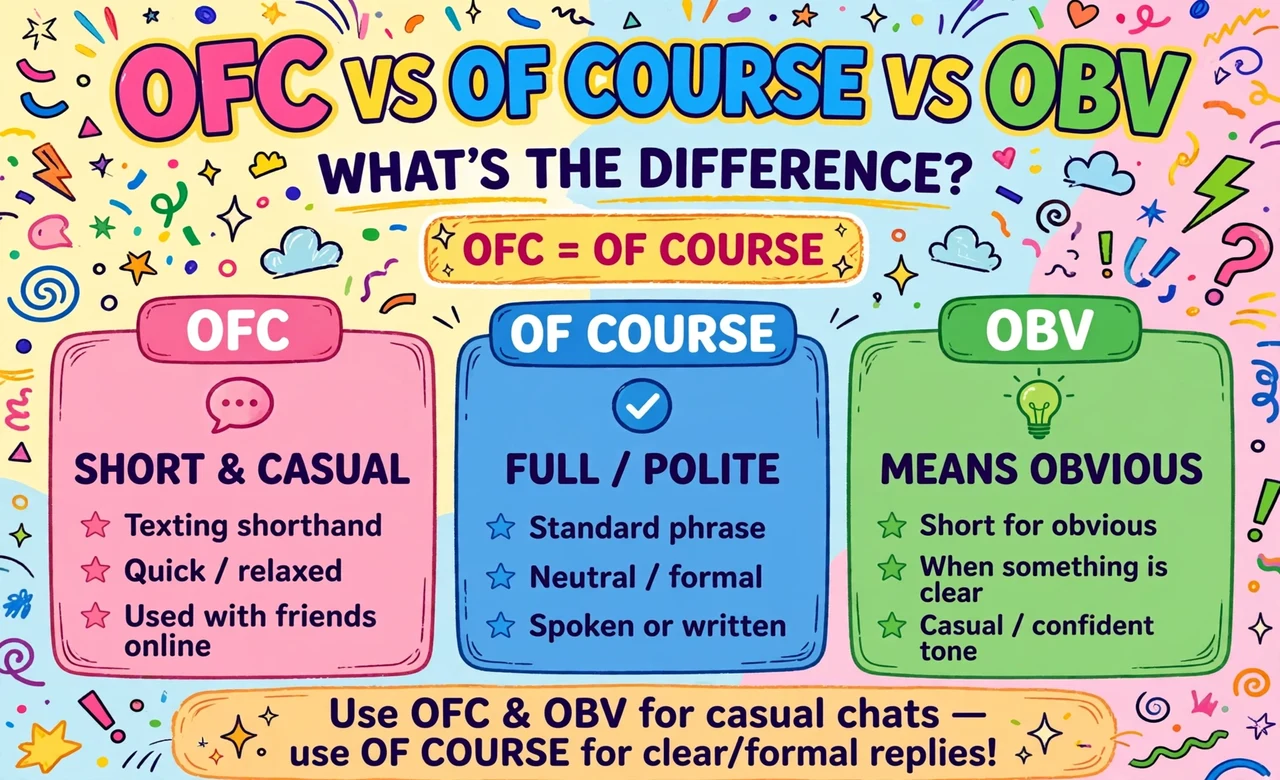
OFC, the full phrase Of Course, and OBV (short for Obviously) all live in the same neighbourhood of meaning, and mixing them up is easy. The key point is short: OFC is the casual short form, Of Course is the full warm form, and OBV is the blunter form.
Here is a clear comparison:
| Term | Full Meaning | What It Does | Example Sentence |
|---|---|---|---|
| OFC | Of Course | Quick casual yes or agreement, confident and fast | “Are you coming?” “OFC.” |
| Of Course | Of Course | Warm, polite agreement, safe in every setting | “Of course, I would love to help.” |
| OBV | Obviously | Blunt agreement, can sound sharper or more sarcastic | “OBV, who would not want that?” |
OFC and Of Course are the closest pair, and the difference is mostly about formality and length. OFC is the texting shortcut: fast, casual, at home in chats and comments. Of Course is the full phrase: warmer, safer, and fine everywhere, including work emails and formal messages. If you are unsure whether your reader knows slang, the full phrase is always the kinder choice.
OBV is the blunt cousin. It carries the same “the answer was obvious” energy as OFC, but with a sharper edge. OBV can sound more sarcastic than OFC, and it is less common in warm or polite messages. Where OFC can be enthusiastic, OBV is more often dry. Knowing this difference helps you pick the right one: use OFC for friendly confidence, OBV only when you want that sharper tone.
A simple way to keep them straight:
- Use OFC when you want a fast, casual, confident yes in a chat.
- Use Of Course when you want warmth, politeness, or safety in a formal setting.
- Use OBV when you want a blunt, dry “obviously,” and you are sure the reader will take it well.
None of the three is better in general. They are tools for different moments, and the best texters switch between them without thinking.
12 Real Chat Examples of OFC
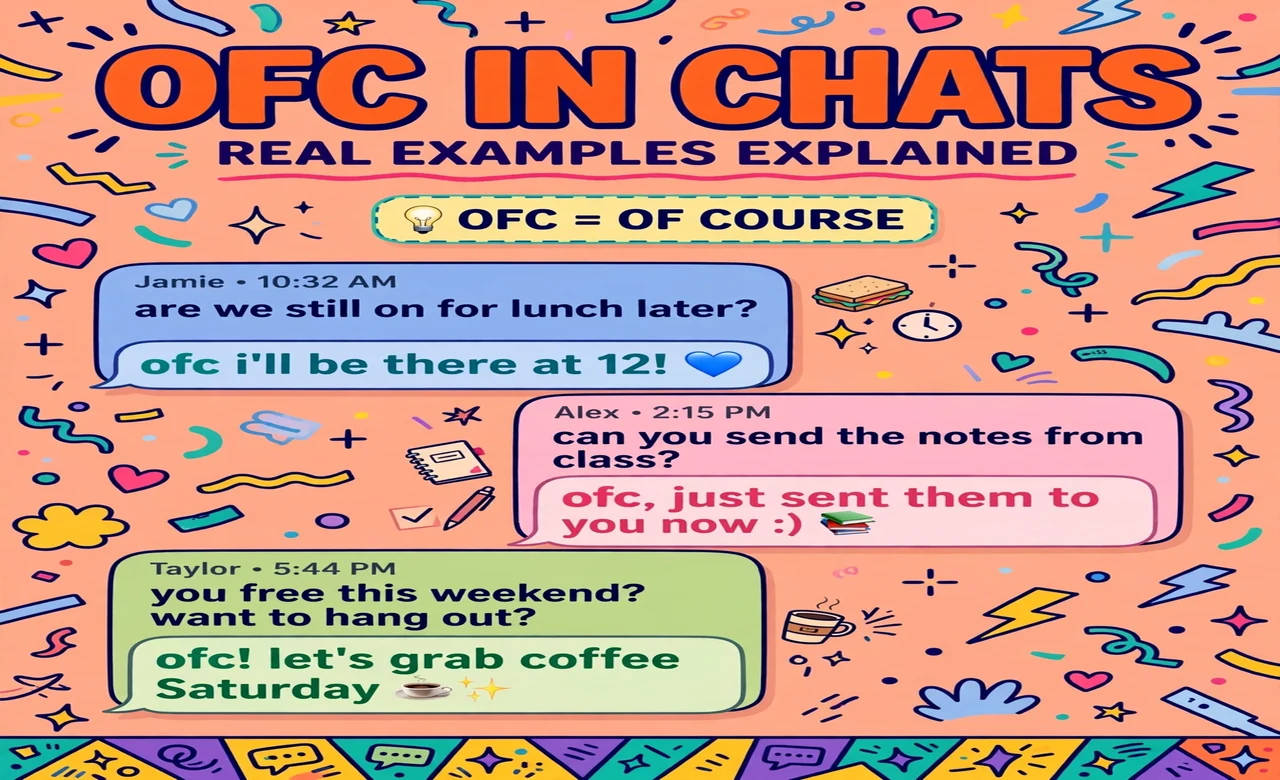
Here are realistic conversations showing OFC in action, across Snapchat, Instagram, TikTok and everyday texting. Notice how the setting and the sentence around OFC tell you the tone every time.
Snapchat planning chat, casual:
Friend 1: “Beach tomorrow, you in?”
Friend 2: “OFC.”
Instagram DM, friendly:
Sara: “Did you see the new episode last night?”
Ayesha: “OFC, that twist at the end was unreal.”
Instagram comment, enthusiastic agreement:
Creator: “POV: your weekend plans actually happen.”
Comment: “OFC.”
TikTok comment, strong agreement:
Video caption: “Nobody: … Me at 3 am: one more episode.”
Comment: “OFC, this is literally me.”
Texting, planning with detail:
Friend 1: “Dinner at 7, can you make it?”
Friend 2: “OFC, I will be there at 7.”
Texting, casual agreement:
Friend 1: “This week feels endless.”
Friend 2: “ofc, I am so ready for Friday.”
Texting, OFC as emphasis:
Partner 1: “OFC the best part of the trip was the food.”
Partner 2: “Agreed, I am still thinking about that restaurant.”
Funny texting exchange:
Friend 1: “Are you actually going to study tonight?”
Friend 2: “OFC.”
Friend 1: “Liar, you said that yesterday too.”
Friend 2: “OFC, but this time I mean it.”
Funny sarcastic exchange:
Friend 1: “Do you think I am funny?”
Friend 2: “OFC…”
Friend 1: “The dots are doing a lot of work here.”
Friend 2: “OFC they are.”
Work chat, quick confirmation:
Colleague: “Can you send the report by 5?”
You: “OFC, sending it now.”
In each case, the meaning is clear from context: a question gets a quick yes, a statement gets agreement, a sentence gets emphasis, and a work setting would be the only place to read Office instead. When the tone is enthusiastic, the reply can be warm. When it is sarcastic, play along. When it is casual, a simple reply is fine.
Common Mistakes People Make with OFC
OFC is simple, but a few common mistakes still trip people up. Knowing them will save you from awkward replies.
Mistake 1: Reading OFC as Office in a Normal Chat
The most common mistake is carrying the Office meaning into a normal conversation. If a friend texts “Want to come over?” and you reply “OFC,” nobody thinks you are talking about a workplace. But in an office chat, “OFC” can mean the building. The fix is simple: let the setting decide. Normal chat means Of Course. Work chat about locations means Office. If you are the one writing OFC in a work chat and you mean Of Course, write it out in full to avoid the mix up.
Mistake 2: Taking Sarcastic OFC Personally
A dry “OFC…” after a silly question can look sharp on screen, and some readers take it as rudeness. In most cases, it is not. It is friendly teasing, and among close friends it is a sign of comfort, not conflict. Before you read attitude into a sarcastic OFC, check the relationship. If the person teases you often, their “OFC…” is normal for them. If you are not close to the person, they probably did not mean it sarcastically in the first place.
Mistake 3: Treating Casual OFC as Cold
A plain “ofc” with no exclamation point and no emoji can look flat on screen, and some readers take it as cold or uninterested. In most cases, it is not. It is just a fast, low energy yes in a fast conversation. Before you read attitude into a casual OFC, check the person’s usual style. If they always text in short replies, their “ofc” is normal for them. If you want your own OFC to sound warmer, add one small word, like “ofc, thanks” or “ofc, sounds good.”
Mistake 4: Replying to OFC as Emphasis Instead of the Sentence
When OFC appears inside a sentence, like “OFC the best pizza is downtown,” some people reply to the OFC itself, with something like “of course what?” That misses the point. The OFC is just a booster. Reply to the opinion in the sentence, not to the booster. “I have been meaning to try that place” is a natural reply. “Of course what” stops the conversation.
Mistake 5: Using OFC Where a Detail Is Needed
“OFC” is a complete yes, but a yes without a detail can still leave the other person stuck. If someone asks “Can you pick me up?” and you reply “OFC,” they still do not know when. A reply like “OFC, be there in 10” answers the real question. This mistake is easy to fix: whenever OFC is your answer to a planning question, add the time, the place or the detail that the question was really asking for.
Mistake 6: Using OFC with People Who Do Not Know Slang
Sending a bare “OFC” to someone outside the usual slang age range, like a grandparent or a formal contact, can cause real confusion. They may read it as a typo or not understand it at all. The fix is kindness: write “Of course” in full when you are not sure the reader knows the abbreviation. Slang is only useful when the other person speaks it too.
None of these mistakes is serious, and all of them are fixed by the same habit: read the sentence around OFC, check the setting and the tone, and match your reply to what the other person actually needs. Do that, and OFC will never confuse you.
When to Use OFC and When Not To
OFC fits naturally in casual chats, fast replies and friendly agreement, but it is not right for every setting. Use this short guide to decide.
When to Use OFC
Use OFC when:
- You are answering a question with a quick, confident yes in a casual chat, for example “Are you in?” “OFC.”
- You are agreeing with a friend’s opinion, for example “That was amazing.” “OFC.”
- You are adding emphasis inside a sentence, for example “OFC the best day ever.”
- You are replying on Snapchat, Instagram DMs or TikTok comments, where short replies are the normal style.
- You are teasing a close friend with a playful sarcastic OFC, and you are sure they will laugh.
- The people you are writing to know texting slang, so the message will be clear at once.
Used this way, OFC is fast, friendly and clear. It saves typing, it fits the rhythm of the app, and it gets your confident yes across without delay.
When Not to Use OFC
Do not use OFC when:
- You are writing to someone who may not know texting slang, and a bare “OFC” would confuse them. Write “Of course” in full instead.
- You are writing a formal email, a job application or an official message, and OFC would look too casual. Use a full sentence instead.
- You are in a work chat and you mean Of Course, because colleagues there may read OFC as Office. Write “of course” in full to avoid the mix up.
- You are sharing something serious, emotional or urgent, and a short OFC reply could feel dismissive. A fuller, kinder reply is better in that case.
- You need to give a detail, like a time or a place, and OFC alone does not include it. Add the detail: “OFC, see you at 7” is far more helpful than “OFC” on its own.
- The sarcastic tone could land wrong, for example with someone you do not know well. Keep sarcastic OFC for close friends.
A good rule is this: if the reader needs more than the letters OFC to understand you, give them one more word. OFC plus a detail, like “OFC, I am in” or “OFC, sending now,” is almost always better than OFC alone. That one detail is the difference between a fast message and a confusing one.
Frequently Asked Questions About OFC Meaning
1. What does OFC mean in text?
OFC means Of Course. It is a short, casual way to say yes, obviously, definitely, or naturally. This is the settled texting meaning, and it is the meaning you should assume first in almost every chat.
2. What does OFC mean on Snapchat?
On Snapchat, OFC means Of Course. Snapchat chats are short and fast, and OFC fits that style as a quick yes, a confirmation, or an agreement. If a friend replies “OFC” to your snap or chat, they are agreeing with you or confirming a plan, with the feeling that the answer was expected.
3. What does OFC mean in text messages?
In text messages, OFC means Of Course, used as a quick yes to a question, agreement with a statement, or emphasis inside a sentence. For example, “Are you coming?” “OFC.” A bare “OFC” is a confident yes in a normal chat.
4. What does OFC mean on Instagram?
On Instagram, OFC means Of Course. It appears in comments as strong agreement, like “obviously,” and in DMs as a quick yes or confirmation. Unless the setting is a work chat, OFC on Instagram is Of Course.
5. What does OFC mean on TikTok?
On TikTok, OFC means Of Course, most often in comments as enthusiastic agreement with a video. A comment that just says “OFC” is like saying “obviously” or “exactly.” In TikTok DMs, it works like any quick yes.
6. What is the ofc slang meaning in chats?
The ofc slang meaning is Of Course, used as a fast casual yes or agreement. It is the same meaning in chats, on Snapchat, Instagram and TikTok. It is not a separate slang word with a secret meaning. It is just the short form of Of Course.
7. Does OFC mean Office?
Only in some work chats. In workplace conversations about locations and schedules, OFC can be short for Office, as in “I am at the OFC today.” In every normal chat, snap or comment, OFC means Of Course, so do not assume Office unless the setting is clearly about work.
Conclusion
Now you know the full story behind ofc meaning in text, and the honest truth that makes this one easy and fun: OFC has a settled texting meaning, and it is Of Course. When you ask what does ofc mean, the best answer in almost every case is a quick confident yes, an agreement, or an emphasis, said in three letters. The ofc meaning on snapchat is the same Of Course, fitting the fast rhythm of snaps and short chats. The ofc in texting is the same too, whether it answers a question, agrees with an opinion, or boosts a sentence from the inside.
The secondary use deserves honesty, not confusion. Office is real, but only in work chats about locations, where the schedule and the setting make it obvious. Start with Of Course, switch to Office only when the conversation is clearly about the workplace, and you will read OFC correctly every time. And when OFC meets its close relatives, remember the simple split: OFC is the casual confident short form, Of Course is the warm full form safe everywhere, and OBV is the blunter sharper form.

Hi, I’m Alice, a writer at HubMeanings, where I make confusing words, slang, and phrases easy to understand.
I love exploring language and sharing clear, simple meanings with practical examples.