
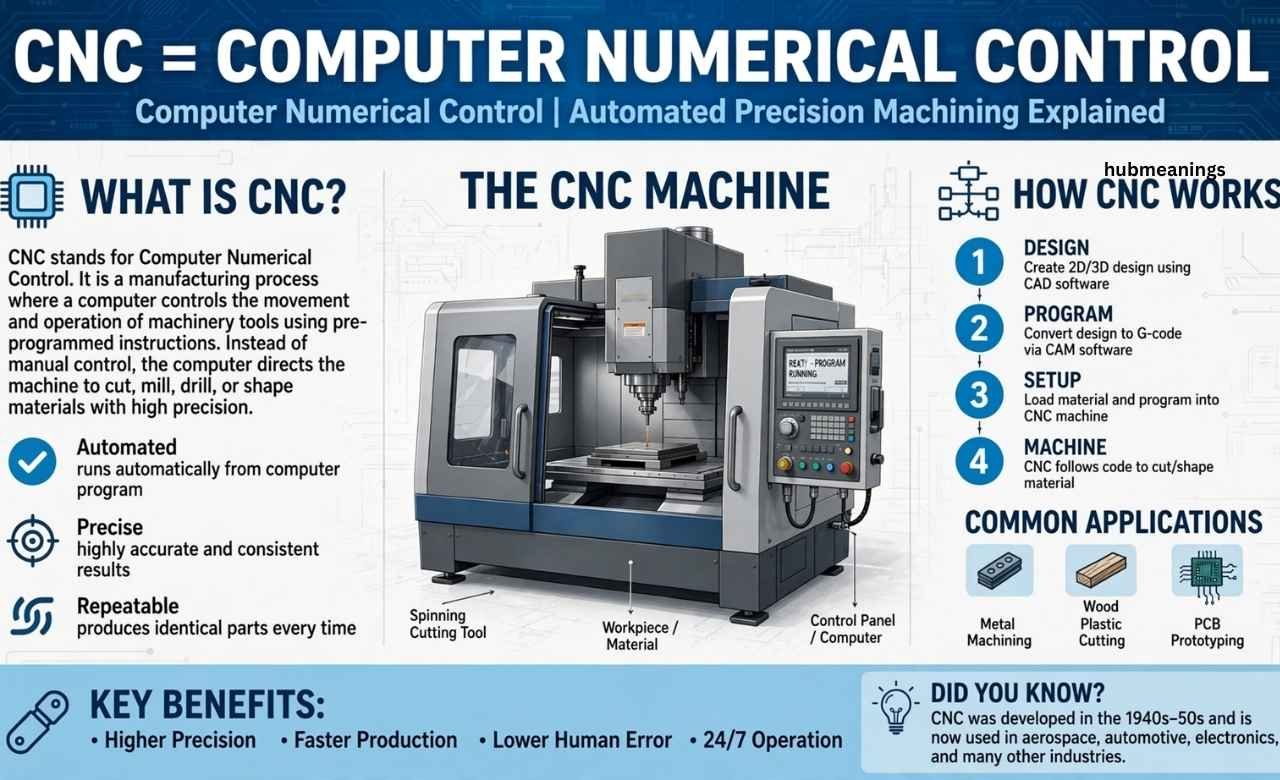
The CNC meaning can be confusing because the abbreviation is used in several completely different contexts. In manufacturing and engineering, CNC usually stands for Computer Numerical Control, a technology that allows machines to follow computer-programmed instructions with high precision. CNC machines are widely used for milling, turning, cutting, drilling, engraving, and routing.
However, CNC meaning in text, chat, dating, and slang can refer to something entirely different. In some online relationship and adult communities, CNC is an abbreviation for Consensual Non-Consent, a term describing a pre-agreed roleplay dynamic involving negotiated boundaries and consent.
This guide explains the CNC full form, CNC meaning in manufacturing and engineering, how CNC machines work, CNC programming, woodworking, metal cutting, and the different meanings of CNC in text and relationship conversations. Because the abbreviation is highly context-dependent, understanding the surrounding conversation is essential.
CNC Full Form Explained

The most common technical CNC full form is Computer Numerical Control.
Computer Numerical Control refers to a system in which a computer controls a machine tool by following programmed numerical instructions. Instead of manually moving cutting tools, an operator prepares or loads a digital program that tells the machine how to perform specific operations.
The basic idea is straightforward:
Computer program → Machine controller → Motors and machine tools → Finished component
CNC technology is primarily associated with manufacturing and precision machining. It allows manufacturers to produce complex parts repeatedly while maintaining consistent dimensions and quality.
The term numerical control comes from the use of numerical and coded instructions to control machine movements. Modern CNC systems combine this concept with computer technology, making machines significantly more flexible and programmable.
What Does CNC Stand For?
CNC stands for Computer Numerical Control when the discussion involves manufacturing, engineering, machining, or industrial equipment.
For example:
- CNC machine = Computer Numerical Control machine
- CNC machining = Computer Numerical Control machining
- CNC programming = programming instructions used to control a CNC machine
- CNC manufacturing = manufacturing using computer-controlled machinery
- CNC machinist = a professional who sets up, operates, or programs CNC equipment
However, CNC does not always mean Computer Numerical Control. In texting, dating, and certain online communities, it can have a different meaning.
That is why the context surrounding the abbreviation matters.
CNC Meaning in Manufacturing
In manufacturing, the CNC meaning is closely associated with automated and precision-controlled production.
A CNC machine receives instructions from a digital program and uses those instructions to control movements such as positioning, cutting, drilling, turning, or engraving. Depending on the machine, movement can occur along multiple axes.
Common CNC manufacturing applications include:
- Automotive components
- Aerospace parts
- Medical devices
- Industrial machinery
- Electronic components
- Metalworking
- Plastic parts
- Furniture production
- Custom prototypes
- Precision mechanical components
CNC manufacturing is especially valuable when a company needs accurate components that can be produced repeatedly.
For example, if a manufacturer needs hundreds of identical aluminum brackets, manually producing each one could take considerable time and introduce variation. A properly programmed CNC machine can reproduce the same toolpath repeatedly.
Common CNC machines:
CNC Mill
A CNC mill uses rotating cutting tools to remove material from a workpiece. CNC milling is commonly used for producing slots, holes, pockets, surfaces, and complex three-dimensional shapes.
CNC Lathe
A CNC lathe generally rotates the workpiece while a cutting tool moves against it. CNC turning is particularly useful for cylindrical components such as shafts, bushings, and threaded parts.
CNC Router
A CNC router is commonly used for wood, plastics, composites, and some softer materials. It is popular in woodworking, furniture production, signage, carving, and engraving.
CNC Plasma Cutter
A CNC plasma cutter uses a plasma arc to cut electrically conductive materials. It is often used for sheet metal and fabrication work.
CNC Laser Cutter
A CNC laser cutter uses a focused laser beam to cut or engrave materials. Applications vary depending on the machine and material.
CNC Grinder
CNC grinding machines use abrasive wheels to achieve highly precise surfaces and dimensions.
CNC Drilling Machine
CNC drilling equipment automatically positions and drills holes according to programmed instructions.
The exact capabilities of a CNC machine depend on its design, controller, tooling, software, material, and number of controlled axes.
CNC Machining Meaning
CNC machining is a subtractive manufacturing process in which a computer-controlled machine removes material from a workpiece to create a desired shape.
The material may be metal, plastic, wood, composite material, or another machinable substance.
The CNC machining process commonly involves several stages:
- Designing the component
- Creating or preparing a CAD model
- Developing a manufacturing strategy
- Creating toolpaths with CAM software
- Generating machine instructions
- Setting up the CNC machine
- Loading the material
- Installing appropriate cutting tools
- Running the program
- Inspecting the finished component
The objective is to transform a digital design into a physical part accurately and efficiently.
Key benefits of CNC machining:
High precision
CNC machines can perform highly controlled movements, making them suitable for precision manufacturing.
Repeatability
Once the setup and program are properly established, the machine can reproduce the same operations repeatedly.
Complex shapes
Computer-controlled toolpaths can produce geometries that may be difficult or time-consuming to create manually.
Reduced manual intervention
Automation reduces the amount of continuous manual movement required during machining.
Efficient production
CNC equipment can be particularly useful for production runs where consistent components are required.
Flexible manufacturing
A CNC machine can often produce different components by changing tooling, setup, and programming.
Improved consistency
Digital instructions can help maintain consistent machining operations across multiple parts.
CNC machining does not eliminate the need for skilled workers. Programming, setup, tooling selection, inspection, maintenance, and quality control still require technical knowledge.
CNC Machine Working Principle
The CNC machine working principle is based on converting digital instructions into controlled physical movements.
A simplified process looks like this:
CAD design → CAM toolpath → CNC code → Machine controller → Motor movement → Cutting operation
First, a component is designed using computer-aided design (CAD) software. The design contains the dimensions and geometry required for the finished part.
Next, computer-aided manufacturing (CAM) software can be used to generate toolpaths. A toolpath determines how the cutting tool should move.
The resulting instructions are then transferred to the CNC controller.
The machine controller interprets the program and sends commands to motors and other machine components.
Depending on the machine, these movements can occur along X, Y, and Z axes or additional rotary axes.
For example, a basic milling operation might involve:
- X-axis movement
- Y-axis movement
- Z-axis movement
- Spindle rotation
- Controlled feed movement
The spindle rotates the cutting tool, while the machine precisely controls its position relative to the workpiece.
What are G-code and M-code?
G-code generally contains instructions related to machine movement and machining operations.
M-code is commonly used for auxiliary machine functions, such as controlling certain machine operations.
The exact code structure and available commands vary between CNC controllers and machines.
Modern CNC systems can also include advanced features such as tool compensation, automatic tool changers, probing systems, feedback systems, and sophisticated control interfaces.
CNC Meaning in Engineering

In engineering, the CNC meaning usually refers to Computer Numerical Control and its application in precision manufacturing.
CNC technology is important in mechanical engineering, manufacturing engineering, industrial engineering, product development, and related technical fields.
Engineers may use CNC systems to manufacture:
- Prototypes
- Mechanical components
- Machine parts
- Fixtures
- Tooling
- Housings
- Shafts
- Gears
- Brackets
- Precision assemblies
CNC manufacturing also supports product development. Engineers can create a digital design, manufacture a prototype, evaluate it, make modifications, and produce another version.
This makes CNC technology useful throughout the design-to-production process.
In engineering environments, factors such as material properties, tolerances, surface finish, cutting forces, tool selection, machine capability, and production requirements all influence the machining process.
CNC Meaning in Metal Cutting
In metalworking, CNC refers to the computer-controlled operation of machine tools used to remove or shape metal.
CNC metal cutting can include operations such as:
- Milling
- Turning
- Drilling
- Boring
- Threading
- Grinding
- Routing
- Profile cutting
Different metals require different machining strategies.
Aluminum, steel, stainless steel, titanium, brass, and other materials can have very different cutting characteristics. Tool selection, spindle speed, feed rate, cutting depth, coolant strategy, and machine rigidity may all affect the final result.
For example, CNC milling can create pockets and slots in a metal block, while CNC turning can produce cylindrical parts.
The main objective is to remove the required amount of material while maintaining the desired dimensions and surface quality.
CNC Programming Meaning
CNC programming means creating the instructions that tell a CNC machine how to perform a manufacturing operation.
A CNC program can define information such as:
- Tool movements
- Coordinates
- Feed rates
- Spindle speeds
- Tool changes
- Machine functions
- Cutting paths
- Workpiece positioning
CNC programmers may create programs manually, through CAM software, or through a combination of both approaches.
Modern manufacturing frequently uses CAD and CAM systems to generate complex toolpaths.
A simplified CNC programming workflow might look like this:
Design → Tool selection → Toolpath creation → Simulation → Code generation → Machine setup → Production
Before running a program on an actual machine, manufacturers may simulate the toolpath to identify potential problems.
This is important because programming errors can result in incorrect parts, tool damage, machine collisions, or wasted material.
CNC programming therefore requires an understanding of geometry, machining processes, tooling, machine capabilities, coordinate systems, and CNC controls.
CNC Meaning in Woodworking
In woodworking, CNC commonly refers to Computer Numerical Control woodworking machines, especially CNC routers.
A CNC router can automatically cut, carve, drill, profile, or engrave wooden materials according to digital instructions.
CNC woodworking is used for:
- Furniture making
- Cabinet components
- Decorative panels
- Signs
- Engraving
- Custom designs
- Wood carving
- Prototyping
- Architectural components
One major advantage is the ability to reproduce detailed designs consistently.
For example, a furniture maker can create a digital design and use a CNC router to cut multiple components with matching dimensions.
CNC woodworking can also reduce repetitive manual cutting and make complex decorative patterns easier to reproduce.
However, the quality of the finished product still depends on factors such as machine calibration, tooling, wood type, workholding, feed rate, spindle speed, and programming.
CNC vs Manual Machining (Key Difference)
The biggest difference between CNC and manual machining is how machine movements are controlled.
In manual machining, an operator directly controls machine movements using handwheels, levers, controls, or other manual mechanisms.
In CNC machining, programmed digital instructions control the machine.
| Feature | CNC Machining | Manual Machining |
|---|---|---|
| Control | Computer-controlled | Operator-controlled |
| Repeatability | Generally high | Depends heavily on operator |
| Complex shapes | Easier to automate | Often more difficult |
| Programming | Required | Usually not required |
| Setup | Can be complex | Often simpler for basic jobs |
| Production runs | Highly suitable | Can be slower |
| Operator skill | Programming/setup/operation | Direct machine operation |
| Automation | High | Limited |
Neither method is universally better.
Manual machining can be useful for simple repairs, one-off jobs, training, maintenance, and situations where setting up CNC equipment would not be efficient.
CNC machining is particularly valuable for precision components, repeated production, complex geometries, and automated manufacturing.
CNC Meaning in Industrial Automation
In industrial automation, CNC is an important technology for controlling machine tools and manufacturing operations.
Industrial automation involves using machines, software, sensors, controllers, and other systems to reduce manual intervention and improve production processes.
CNC systems can work as part of broader automated manufacturing environments.
For example, a modern production system may combine:
- CNC machines
- Robots
- Automated material handling
- Sensors
- Inspection systems
- Production management software
- Tool monitoring
- Quality-control systems
CNC equipment can also communicate with other manufacturing systems, depending on the factory’s technology and infrastructure.
This makes CNC technology an important part of modern smart manufacturing and factory automation.
Automation can help manufacturers improve productivity, consistency, and production planning while reducing repetitive manual work.
CNC Meaning in Text, Chat, and Slang
The CNC meaning in text depends heavily on context.
When CNC appears in a manufacturing, engineering, or workplace conversation, it almost certainly refers to Computer Numerical Control.
For example:
“I work with CNC machines.”
Here, CNC clearly refers to computer-controlled manufacturing equipment.
But if CNC appears in an online dating, relationship, or adult-community conversation, it may have a completely different meaning: Consensual Non-Consent.
This is why simply seeing the abbreviation “CNC” is not enough to determine its meaning.
CNC meaning in text or chat:
Common interpretations include:
Computer Numerical Control
Used in manufacturing, engineering, machining, woodworking, and industrial discussions.
Consensual Non-Consent
Used in some relationship, adult, and BDSM-related communities to describe a negotiated roleplay dynamic involving consent.
The meaning can also vary depending on the particular online community.
When you see CNC in a message, consider:
- What is the conversation about?
- Is the person discussing machines or manufacturing?
- Is the conversation about relationships?
- Is it an online community where specialized slang is common?
- What words appear before and after CNC?
Context is the best way to interpret an abbreviation accurately.
CNC Meaning in Relationship / Dating / Slang
In some relationship, dating, and adult-community contexts, CNC can stand for Consensual Non-Consent.
The term describes a form of roleplay in which participants voluntarily agree beforehand to simulate a scenario involving a lack of consent.
Despite the phrase itself, the defining feature is prior and ongoing consent. Participants establish boundaries, expectations, and safety measures before engaging in the roleplay.
This terminology is often associated with BDSM communities and other adult relationship discussions.
Important concepts can include:
- Mutual agreement
- Clearly negotiated boundaries
- Communication
- Safe words or signals
- Ability to stop
- Trust
- Aftercare
- Respect for boundaries
The term should not be interpreted as meaning that actual non-consensual behavior is acceptable. Real consent cannot be assumed, and a person’s boundaries must always be respected.
For someone unfamiliar with the terminology, CNC can therefore be confusing because the abbreviation looks identical to the manufacturing term.
CNC meaning on social media
On social media platforms, CNC can appear in different communities.
For example:
- Manufacturing accounts may use CNC to discuss machines.
- Engineering communities may discuss CNC programming.
- Woodworking creators may use CNC to describe routers and carving machines.
- Relationship-focused communities may use CNC as relationship slang.
- Adult-oriented communities may use CNC to refer to consensual roleplay.
Therefore, CNC meaning on TikTok, Reddit, Discord, or another social platform cannot always be determined from the abbreviation alone.
The surrounding content provides the necessary context.
Is CNC a Bad Word?
CNC is not inherently a bad word.
In manufacturing, CNC simply means Computer Numerical Control and is a standard technical abbreviation.
For example, engineers, machinists, manufacturers, and woodworking professionals use CNC as an ordinary industry term.
However, in certain online relationship or adult contexts, CNC can refer to Consensual Non-Consent, which is an adult relationship or roleplay term.
Whether the abbreviation is appropriate depends on the conversation, audience, and context.
If you are discussing manufacturing, using CNC is completely normal.
If you are talking about relationships or adult topics, the abbreviation may have a sensitive meaning and should be understood carefully before being used.
This is a good example of why abbreviations can have multiple meanings across different communities.
Meaning of CNC Machinist
A CNC machinist is a skilled professional who works with computer-controlled machine tools to manufacture precision components.
Depending on the workplace, a CNC machinist may perform tasks such as:
- Setting up machines
- Loading materials
- Installing cutting tools
- Adjusting machine parameters
- Loading or modifying programs
- Inspecting finished parts
- Measuring dimensions
- Monitoring machining operations
- Performing basic troubleshooting
- Maintaining tooling and equipment
A CNC machinist needs both practical and technical knowledge.
Important skills can include understanding:
- Engineering drawings
- Measurements
- Tolerances
- Cutting tools
- Machine operation
- CNC controls
- Workholding
- Materials
- Quality inspection
Some CNC machinists also develop programming skills and can create or modify CNC programs.
The role is important because automation does not remove the need for human expertise. Instead, modern CNC manufacturing combines automated machine control with skilled workers who prepare, monitor, inspect, and improve production processes.
Why CNC Is Important Today
CNC technology is important because modern manufacturing requires precision, consistency, flexibility, and efficient production.
Industries such as aerospace, automotive, medical manufacturing, electronics, energy, construction, and industrial equipment rely on precision components.
CNC machines make it possible to manufacture many of these components using controlled digital instructions.
Precision manufacturing
Many modern products require components manufactured within tight tolerances.
CNC equipment can provide highly controlled machine movements when properly programmed, set up, and maintained.
Repeatable production
Manufacturers often need large quantities of identical components.
Once a CNC process is properly developed, the same program and setup can be used to produce repeated parts, subject to appropriate inspection and process control.
Complex designs
Modern product designs can include complex curves, pockets, holes, contours, and three-dimensional surfaces.
Multi-axis CNC machines can make many of these geometries more practical to manufacture.
Faster product development
CNC equipment can support rapid prototyping.
Engineers can move from a digital CAD model to a physical prototype without creating an entirely manual manufacturing process.
Flexible manufacturing
CNC machines can often be reprogrammed for different products.
This flexibility makes CNC useful for both prototypes and production environments.
Integration with automation
CNC systems can operate alongside robots, automated inspection, digital production systems, and other industrial technologies.
As manufacturing becomes increasingly connected and automated, CNC remains a fundamental technology.
CNC Manufacturing Process Explained
To understand the CNC manufacturing process, it helps to look at the complete workflow.
Step 1: Create the design
The process normally starts with a digital design created in CAD software.
The CAD model defines the shape and dimensions of the desired component.
Step 2: Plan the machining operation
The manufacturer determines how the part should be produced.
This can involve selecting:
- Machine type
- Cutting tools
- Workholding method
- Material
- Machining sequence
- Cutting parameters
Step 3: Create toolpaths
CAM software can convert the digital design into toolpaths.
The toolpath determines where the cutting tool moves and how material is removed.
Step 4: Generate CNC code
The CAM system can generate machine instructions suitable for the selected CNC controller.
Step 5: Set up the machine
The operator prepares the CNC machine by installing the necessary tooling, securing the workpiece, setting work offsets, and preparing the program.
Step 6: Run the machining operation
The CNC machine follows its programmed instructions.
The cutting tools remove material until the required geometry is produced.
Step 7: Inspect the part
The finished component is measured and inspected to verify that it meets the required specifications.
This final stage is essential for quality control.
CNC Milling vs CNC Turning
Two common CNC machining processes are milling and turning.
CNC milling
In CNC milling, the cutting tool rotates while the machine controls its movement relative to the workpiece.
CNC milling is commonly used for:
- Slots
- Pockets
- Holes
- Flat surfaces
- Contoured surfaces
- Complex components
CNC turning
In CNC turning, the workpiece generally rotates while the cutting tool moves along or toward the material.
CNC turning is especially useful for:
- Shafts
- Pins
- Bushings
- Cylindrical components
- Threads
- Rotational parts
The best process depends on the geometry and manufacturing requirements of the component.
CNC Machine Axes Explained
CNC machines control movement using axes.
A basic three-axis CNC machine commonly uses:
X-axis: horizontal movement in one direction.
Y-axis: horizontal movement in the perpendicular direction.
Z-axis: movement generally associated with vertical or tool-depth positioning.
More advanced CNC equipment can include additional rotary axes.
A 5-axis CNC machine, for example, can control multiple linear and rotary movements, allowing the cutting tool to approach a component from different orientations.
The number of axes influences the types of geometries a machine can efficiently produce.
CNC Applications in Different Industries
CNC technology is used across many industries.
Aerospace
Aerospace manufacturers require highly precise components and often work with challenging materials and complex geometries.
Automotive
CNC machining is used for prototypes, engine components, tooling, fixtures, and many other automotive parts.
Medical manufacturing
Precision manufacturing is important for many medical devices and components.
Electronics
CNC equipment can manufacture housings, fixtures, panels, and specialized components used in electronics production.
Furniture and woodworking
CNC routers can automate cutting, engraving, carving, and furniture component production.
Industrial equipment
Manufacturers use CNC machines to produce components for pumps, machines, tools, and industrial systems.
CNC Automation vs Traditional Manufacturing
Traditional manufacturing can involve significant manual intervention.
CNC automation changes this by allowing digital instructions to control machine movements.
However, automation does not mean that humans are removed from the manufacturing process.
Workers remain important for:
- Design
- Programming
- Setup
- Tool selection
- Inspection
- Maintenance
- Quality control
- Troubleshooting
The real advantage is the combination of human expertise and automated machine control.
CNC Meaning: Why Context Matters
One of the most important things to remember about CNC meaning is that abbreviations are context-dependent.
Consider these examples:
“The factory bought a new CNC mill.”
Here, CNC means Computer Numerical Control.
“She works as a CNC machinist.”
Again, the meaning is Computer Numerical Control.
“What does CNC mean in this relationship discussion?”
Here, the abbreviation may refer to Consensual Non-Consent.
The same three letters can therefore represent completely different concepts.
If you encounter CNC in a text message, don’t automatically assume one definition. Look at the topic and surrounding words first.
CNC Meaning in Different Contexts
| Context | CNC Meaning |
|---|---|
| Manufacturing | Computer Numerical Control |
| Engineering | Computer Numerical Control |
| Machining | Computer Numerical Control |
| Metalworking | Computer Numerical Control |
| Woodworking | Computer Numerical Control |
| Industrial automation | Computer Numerical Control |
| CNC programming | Computer Numerical Control |
| Texting | Context-dependent |
| Chat | Context-dependent |
| Dating | Often Consensual Non-Consent in relevant communities |
| Adult slang | Consensual Non-Consent |
| BDSM communities | Consensual Non-Consent |
The technical meaning is by far the most common in manufacturing and engineering.
The relationship-related definition is highly context-specific and should not be assumed simply because someone uses the abbreviation online.
CNC Meaning on TikTok, Reddit, and Discord
Social platforms contain communities focused on almost every subject, so the CNC meaning on TikTok, Reddit, Discord, or other platforms depends on the community where the term appears.
A woodworking creator may use CNC while showing a CNC router carving a piece of wood.
An engineering community may use CNC while discussing machine tools, programming, or manufacturing.
A relationship-oriented community may use CNC as adult relationship terminology.
Therefore, the platform itself does not determine the meaning.
Instead, identify the community and topic.
FAQS
What does CNC stand for in slang?
In slang, CNC can stand for Consensual Non-Consent, especially in some adult or BDSM communities.
It describes a pre-agreed roleplay dynamic where boundaries and consent are established beforehand.
What is a CNC romance?
A CNC romance generally refers to a fictional or adult relationship context involving consensual non-consent themes.
The term should not be confused with real non-consensual behavior, because consent and agreed boundaries are essential.
What is a CNC bed?
CNC bed is not a universal term and its meaning depends on context.
In adult or BDSM discussions, it may refer to a bed used as part of a consensual roleplay scenario.
What is CNC dark?
CNC dark is an informal phrase that may describe darker or more intense consensual non-consent themes in adult or fictional content.
Its exact meaning can vary by community, so the surrounding context is important.
Conclusion:
The CNC meaning depends entirely on context.
In manufacturing, engineering, machining, metal cutting, woodworking, and industrial automation, CNC stands for Computer Numerical Control. CNC technology allows machines to follow digital instructions to perform precise and repeatable manufacturing operations.
CNC machining has become an important part of modern manufacturing because it supports precision, repeatability, complex designs, prototyping, and automated production. CNC mills, lathes, routers, grinders, plasma cutters, and laser systems are used across numerous industries.
However, CNC meaning in text, chat, dating, and slang can be different. In certain adult and relationship communities, CNC can stand for Consensual Non-Consent, a term for a negotiated roleplay dynamic that relies on consent and clearly established boundaries.Read other article Lumon Meaning Explained

Hi, I’m Alice, a writer at HubMeanings, where I make confusing words, slang, and phrases easy to understand.
I love exploring language and sharing clear, simple meanings with practical examples.